
WED 2 SEPT - More than 21,000 people have been displaced by renewed fighting in Blue Nile state, according to reports, with both sides believed to be sending additional forces to the region and aid workers warning of a “catastrophic” impact for civilians.
Speaking to Avaaz from Geisan, local aid worker Ali* said he knew of at least seven civilians who had been killed during recent clashes, while others were missing, and that many had been forced from their homes.
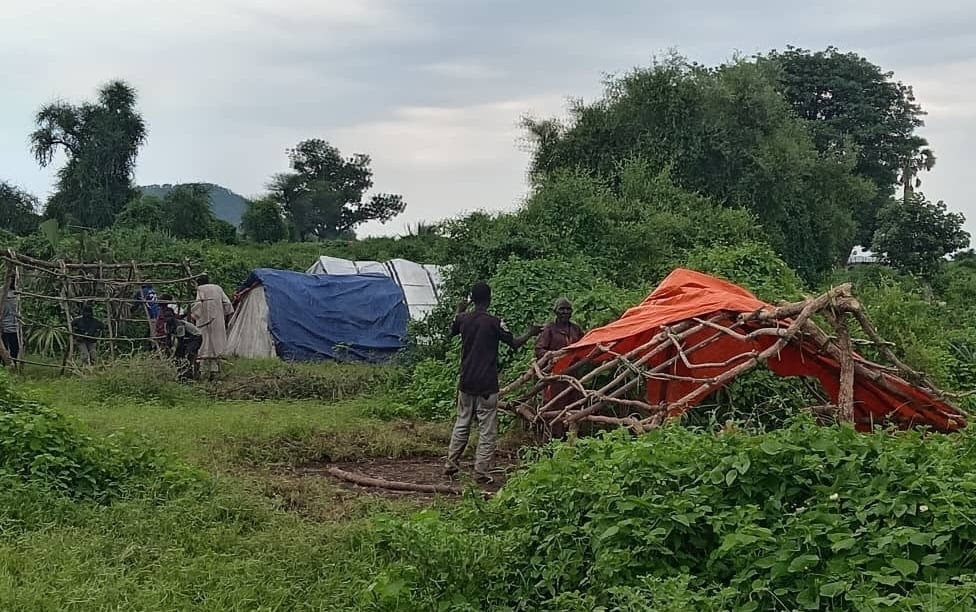
“People are living outside without tents or shelter, including pregnant and breastfeeding women and newborn babies," he said. "There is no safe drinking water now. We are drinking rainwater collected in streams and on the ground."
Blue Nile has seen repeated clashes since the start of the year amid apparent attempts by the Rapid Support Forces (RSF), with the allied Sudan People’s Liberation Movement-North (SPLM-N), to open its supply lines through the territory of neighbouring Ethiopia.
Last month, the group took the town of Geisan, which sits on the border and had long been held by the Sudanese Armed Forces (SAF). Two days later, it seized the town of Kurmuk, a major hub and border transit point, reversing gains made by SAF in July.
On Friday, it claimed to have seized SAF bases in Surkum, part of the Kurmuk region, and Bakouri, part of the Geisan region.
The UN’s Office for the Coordination of Humanitarian Affairs (OCHA) said on Monday that almost 22,000 people were believed to have been displaced by the fighting in the Geisan area over the previous week. Comparable figures were also put out by the Geisan Emergency Response Room and the International Organisation for Migration.
“The humanitarian situation is catastrophic,” Ali said.
“As volunteers, we do not even know where to gather displaced families because there is no place we can say is safe.
“At the moment, we have very little to offer them. Sometimes we can provide only one small meal, mainly for children, because there simply is not enough food.
“Recently, we distributed 200 food baskets and 100 women’s kits containing basic supplies, but this is very little compared with the number of people in need.
“Staying outside during the rainy season makes their situation much worse and makes it extremely difficult for us to provide services.”
Ali said that recent days had seen the RSF advance further into a number of villages in the surrounding area, in some cases prompting much of the population to flee.
He said most of the displaced had gone either east to the Wad Al-Mahi region or north towards state capital Damazin, journeys made even more difficult by fuel shortages and heavy rains.
Photos shared by local volunteers appeared to show people constructing makeshift shelters in a remote area near Geisan.
“People in Blue Nile were already victims of previous wars,” he said. “They had only started to recover, and now another war has pushed them back to zero.”
The past week has seen reports of both sides deploying troops to strengthen their forces in and around Blue Nile.
On Tuesday, SAF announced that reinforcements from the allied Joint Forces had arrived in Damazin to take part in operations to “cleanse” the state of the RSF.
Satellite images published by the Yale Humanitarian Research Lab (HRL) showed a “major escalation” of what was believed to be RSF activity at a military base in the Ethiopian town of Asosa between 23 and 28 August.
Visible in the images were objects consistent with 100 light technical vehicles as well as 15 armoured personnel carriers capable of carrying a combined total of around 750- 1000 personnel.
Previous reporting by Yale HRL suggested commercial vehicles were being delivered to the base, fitted with machine guns, and used by the RSF in attacks in Blue Nile.
Last month’s RSF offensive to take Kurmuk and Geisan was launched in part from Ethiopian territory, Mada Masr reports, citing military sources.
In the last two weeks, SAF has also twice claimed to have shot down an RSF drone that had crossed into Blue Nile “from the direction of Ethiopia”.
Aerial attack destroys two WFP trucks
Two trucks carrying food aid from the World Food Programme (WFP) have been destroyed in an aerial attack in South Kordofan, the organisation has said.
In a statement, the WFP said the trucks were hit outside the city of Dilling on Sunday and had been “clearly marked with WFP banners and flags”.
It said they were en route to the city of Kadugli and carrying 50 metric tons of food, enough to offer “lifesaving assistance” to 5,800 people for one month.
Dilling and Kadugli are both held by SAF but partly surrounded by territory under the control of the RSF and SPLM-N. Long-running sieges on both cities were broken earlier this year, but access remains restricted and concern persists about widespread food insecurity across the region.
It is not clear who was responsible for the strikes.
The WFP said there had been a total of eight aerial attacks on its premises or operations since the start of this year.
“This attack is the latest example of the complex operating environment facing WFP and other humanitarian agencies in Sudan,” it said.
“WFP urges all those engaged in hostilities to respect international humanitarian law by protecting civilians, humanitarian personnel and humanitarian assets. Attacks on aid workers and humanitarian operations are unacceptable and must stop.”
Also this week, a vaccinator with the World Health Organisation (WHO) was killed in an attack on a market in the city of Nahud, around 150km west of Dilling.
The WHO said Fatima Abdelrahman was killed on Saturday while searching for her son following an earlier attack and that she had been set to begin working on a campaign to tackle cholera.
North Kordofan intelligence chief becomes latest RSF defector
The RSF’s intelligence chief in North Kordofan has become the latest senior figure to defect from the group and join SAF.
Abu Bakr Hamouda Dahloub reportedly arrived in Omdurman on Sunday with a force of around 200 fighters as well as significant numbers of military vehicles and weaponry.
Dahloub told state news agency SUNA he had made a mistake by joining the RSF and described the group as a "mini-state of evil”.
SUNA said Dahloud now wanted to “contribute both to exposing the agenda of the foreign-backed militia and to defeating it on the battlefield”.
Sources told Ayin that Dahloub belongs to the Mahamid, a subgroup of the Rizeigat tribe whose leader, Musa Hilal, is a longtime rival of RSF leader Hemedti and whose forces were involved in ground clashes with the RSF earlier this year.
Among recent defectors from the RSF were a number of other members of the Mahamid, including Al-Nour ‘Guba’ Adam and Ali ‘Savannah’ Rizkallah.
The weekly dispatch features the latest developments, first-hand testimony, footage, photos, stats and analysis on Sudan. We can connect you with voices from the ground, experts, and survivors of the war. Get in touch on +44 7514 796 678 or sudan@avaaz.org.
To get this briefing in your inbox each week, sign up here.
Deploying a civilian protection mission offers the most direct path to protecting civilians and stemming atrocities in Sudan, according to a paper published Tuesday.

More than 21,000 people have been displaced by renewed fighting in Blue Nile state, according to reports, with both sides believed to be sending additional forces to the region and aid workers warning of a “catastrophic” impact for civilians.


Avaaz Foundation
110 Golden Lane | London, England, EC1Y 0TG
1330 6th Avenue, Suite 23A | New York, NY 10019, USA



.svg)


