
TUE 28 OCT – Massacres are ongoing in El Fasher following the fall of the city to the Rapid Support Forces (RSF), despite public assurances by the group’s leadership that civilians would be protected, satellite images suggest.
Recent days have seen the Sudanese Armed Forces (SAF) driven from its final strongholds in El Fasher, including the 6th Infantry Division military base, following a siege that lasted more than 18 months.
Fears have long been raised that the RSF’s capture of the city would be followed by attacks against the civilian population, as happened after it took the nearby Zamzam displacement camp in April.
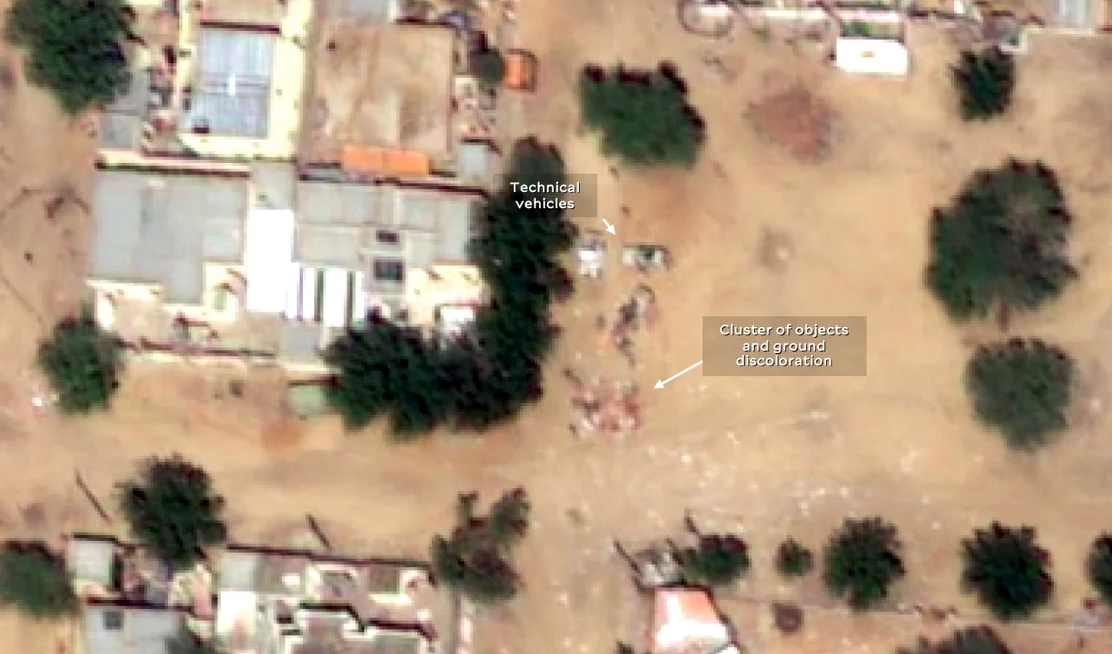
Satellite images published on Monday by the Yale Humanitarian Research Lab (Yale HRL) showed RSF vehicles, some with mounted guns, arranged in “tactical formations consistent with house-to-house clearance operations” in the western Daraja Oula neighbourhood, where many civilians have sought refuge over recent weeks.
Also visible nearby were objects “consistent with the size of human bodies” as well as “at least five instances of reddish earth discoloration”.
Evidence of atrocities has also featured in numerous pieces of footage circulating on social media.
NB: Some of the footage on the links below is graphic. Please watch with caution. You may also need to login to Facebook to view them.
In one video, a number of men, one of whom already has his arm in a sling, are seen having to dodge out of the way of cars before being summarily executed.
In another, a man is seen unarmed and lying on the ground before being shot multiple times at close range.
A third clip shows a group of men who have been detained in the back of a pickup truck being interrogated about where they are from and where they are going.
Two volunteers from El Fasher’s Emergency Response Room were also killed on Monday, while dozens remain missing, sources told Avaaz.
UN Human Rights Chief Volker Turk said on Monday that his office had “received reports of the summary execution of civilians trying to flee, with indications of ethnic motivations for killings, and of persons no longer participating in hostilities”.
On Monday, the International Organization for Migration said an estimated 26,030 people had been displaced from El Fasher across Sunday and Monday.
One humanitarian worker in the Tawila displacement camp, which sits around 50km west of El Fasher, told Avaaz she had never seen “such an extreme level of violence and injuries”.
“The few people who managed to reach Tawila are very very few, they left El Fasher before the fall of the 6th Division, but even they did not escape the systematic violence.
“Many are wounded, weak from hunger and extremely frail. There are children who lost their mothers and fathers along the way, some of them as young as 40 days old. The only ones caring for them are their siblings, who are also children, 10 or 12 years old.
“This morning new arrivals came in with clothes soaked in blood and torn by thorns from the desert along the way. Even as we try to help, many do not survive.”
Shayna Lewis, Sudan Specialist with Avaaz, said: "World leaders were warned. For over two years we've been saying that if the UAE-backed RSF captured El Fasher, they would commit mass atrocities. The horrors we are seeing now - with blood stains that can be seen from space - were predicted and preventable.
"Donor governments like the U.S., U.K., Germany, and France must surge aid now so families fleeing the city can reach food, water, and basic care. If they don’t, more people will die - needlessly.
"We’ve seen this before in Darfur. We must all act now to protect civilians. No more excuses.”
‘El Fasher is safe’, claims RSF leadership
With the fall of El Fasher, the RSF sealed its control of the Darfur region, which makes up much of western Sudan, while SAF remains in control of much of the east, including capital Khartoum.
Acknowledging the fall of El Fasher in a statement on Monday, SAF leader Abdel Fattah al-Burhan said the military leadership in the city had decided to leave so as to “spare the rest of the citizens and the rest of the city from destruction”.
He said SAF and its allies were “capable of achieving victory after victory” and returning “every land that these traitors have defiled to the bosom of the homeland”.
Speaking from the 6th Infantry base, RSF deputy leader Abdelrahim Dagalo similarly vowed that the “liberation of El Fasher means the liberation of all of Sudan”.
“To our forces: anything in El Faher that belongs to citizens must be protected and kept safe. It belongs to the people,” he said.
“To all citizens: return to your homes. We will keep your houses as [they are]. We do not want anything from people’s homes.
“El Fasher is safe under the hands of Tasis [an RSF-led alliance] forces.”

In a statement on Sunday, Tom Fletcher, the UN’s chief humanitarian coordinator, said he was “deeply alarmed” by the situation in El Fasher and called for an immediate ceasefire.
“Hundreds of thousands of civilians are trapped and terrified – shelled, starving, and without access to food, healthcare, or safety. Safe, rapid, and unimpeded humanitarian access must be allowed to reach all civilians in need.”
Killings also reported in North Kordofan
Killings have also been reported after the RSF took control of Bara and Umm Dam Haj Ahmed, two key towns in North Kordofan state.
Bara lies on the main route connecting Darfur and Kordofan to central Sudan, while Umm Dam Haj Ahmed serves as a link between the northern and western parts of the state.
Turk said his office had received reports that dozens of civilians had been killed in Bara and that the RSF was carrying out “summary executions”.
“The RSF must urgently take concrete steps to end and prevent abuses against civilians in both El Fasher and Bara, including ethnically motivated violence and reprisal attacks,” he said.
The RSF is also reported to have launched an attack on Jabal Al-Hashaba, which sits southwest of North Kordofan state capital El Obeid.
The attack appears to be part of a coordinated effort to besiege and isolate El Obeid, a vital trade hub.
With the RSF in control of El Fasher and SAF having retaken Khartoum in March, the Kordofan region forms the frontline between the areas of the country controlled by SAF and the RSF.
Voices From The Ground
Speaking to Avaaz on Monday, a humanitarian worker in the Tawila displacement camp said:
“I have been working in humanitarian aid since the start of this war, and I am currently in Tawila. This is the first time I have witnessed such an extreme level of violence and injuries.
"The few people who managed to reach Tawila are very very few, they left El Fasher before the fall of the 6th Division, but even they did not escape the systematic violence.
"Many are wounded, weak from hunger and extremely frail. The situation is devastating. There are children who lost their mothers and fathers along the way, some of them as young as 40 days old. The only ones caring for them are their siblings, who are also children, 10 or 12 years old.
"Some people die treating them due to exhaustion, hunger, and dehydration as well.
"This morning new arrivals came in with clothes soaked in blood and torn by thorns from the desert along the way. Their condition is heartbreaking. Everyone here is deeply worried about El Fasher and those who couldn't leave. We have no information about them at all.
"As a humanitarian worker, I couldn’t even ask the new arrivals what they saw or what happened to them on the way. They are too traumatized and too weak to speak. As soon as people arrive, we immediately assess what they need - IV fluids, food, water. But even as we try to help, many do not survive.
"We often have to wait a day or two before asking about their experiences because it is clear they’ve suffered trauma, especially women and we suspect many cases of sexual violence. We are preparing to provide psychological support and guidance as best as we can.
"We also trying to coordinate with humanitarian organizations to get food and first aid supplies so that we can continue working.
"Overall, the situation here is critical, beyond words, we are treating the wounded while crying ourselves. It is a catastrophic and heartbreaking situation.”
The weekly dispatch features the latest developments, first-hand testimony, footage, photos, stats and analysis on Sudan. We can connect you with voices from the ground, experts and survivors of the war. I am available at +44 7514 796 678 / sudan@avaaz.org
To get this briefing in your inbox each week, sign up here.
Deploying a civilian protection mission offers the most direct path to protecting civilians and stemming atrocities in Sudan, according to a paper published Tuesday.

More than 21,000 people have been displaced by renewed fighting in Blue Nile state, according to reports, with both sides believed to be sending additional forces to the region and aid workers warning of a “catastrophic” impact for civilians.


Avaaz Foundation
110 Golden Lane | London, England, EC1Y 0TG
1330 6th Avenue, Suite 23A | New York, NY 10019, USA



.svg)


