
FRI 8 AUG – Civilians have been extorted and killed after being told to flee the besieged city of El Fasher, where hundreds of thousands remain trapped and facing starvation.
The city, the last major area of Darfur not under Rapid Support Forces (RSF) control, has been under partial siege for more than a year, with parts already declared to be in a state of famine.
But over recent months a full blockade has been imposed, with people inside describing an increasingly catastrophic shortage of food. Widespread reports suggest many have resorted to eating animal feed in order to survive.
The RSF has set up checkpoints on every major road out of El Fasher, according to the latest report from the Yale Humanitarian Research Lab (HRL). The only exit for civilians is a 50-metre gap in a 6km earthen wall to the city’s north that the group began building in May.
Last week, a spokesman for Tasis, an RSF-led coalition attempting to establish a parallel government for Sudan, urged people to leave the city and head to the village of Garni to the northwest, saying Tasis forces would be deployed to provide protection and aid.
One civilian still inside El Fasher, named Abdo, told Avaaz many of those who followed the instruction were targeted by RSF fighters as they left.
“They told us to leave,” he said. “But they knew exactly what they were doing. It wasn't an evacuation. It was a death sentence.”
“The people who listened… thought they were escaping danger. Instead, they walked straight into it. The RSF was waiting. A lot of them were killed. Slaughtered.”

In one incident on Saturday, at least 14 civilians were killed and dozens were injured after arriving in Garni, according to human rights group Emergency Lawyers.
Garni is on a key supply route for El Fasher and movement within it is heavily restricted by the RSF, making it “one of the most dangerous transit areas for civilians”, the group added.
See the Voices From The Ground section below for Abdo's full testimony
Abdo said other people were detained and tortured before their families were phoned and told to pay a ransom.
“There’s one case I know personally in which a man’s brother in the UK was asked to pay 9 million Sudanese pounds [$15,000]. He did. But after that, they told him the receipts were fake.
“The man is still missing. They took the money and vanished. That’s another crime. Just one of many.”
'Alarming' number of fresh graves identified
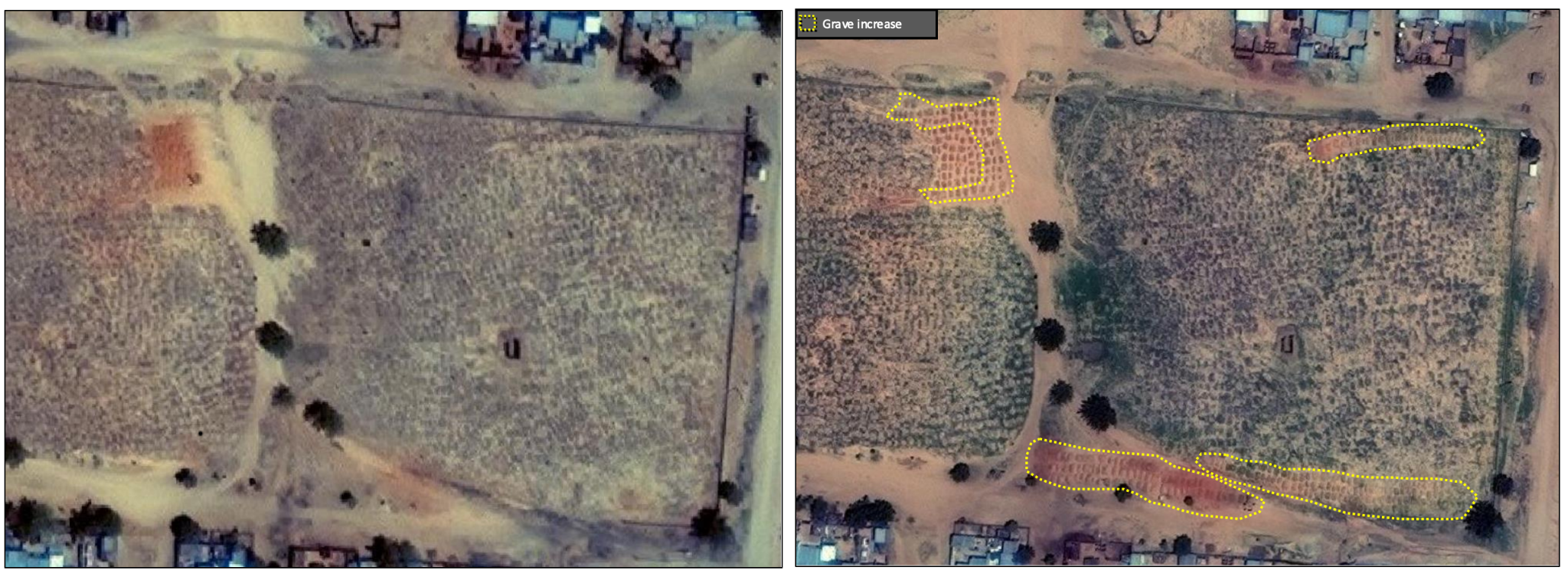
The Yale HRL report also identified what appeared to be new gravesites visible in satellite imagery that suggested an “alarming rate” of mortality.
At least 378 new burial mounds appeared in cemeteries in civilian areas between 9 May and 5 August, it said. In the same period, at least 349 new mounds were seen in areas used by either the RSF, SAF, or the SAF-allied Joint Forces.
While much of the population of El Fasher has fled to displacement camps in the surrounding region, around 300,000 civilians are still believed to be in the city, according to the World Food Programme (WFP).
Yale HRL said two markets, three schools, and two mosques - some of which had served as bomb shelters, centres for disabled people, or community kitchens - had been bombarded by both sides since the end of June.
In a statement on Tuesday, the WFP said it had not been able to deliver food aid to El Fasher by road for more than a year and that, while it was still able to provide cash support to 250,000 people in the city, the provision fell “far short of the massive needs”. Where supplies exist, prices in the markets are astronomical.
Another civilian, named Asim, who left El Fasher in late July after his father was injured by shelling and is now in the east of the country, said there was nothing in the city but “hunger, thirst, and death”.
“Words fail to describe what’s really happening back there,” he said.
“What we need now is pressure. The world must act. The siege on El Fasher must be broken. The RSF needs to be held accountable and pressured into allowing aid through.”
Voices from the Ground
Interviews available on request. Names have been changed due to safety concerns.
Speaking to Avaaz about the directive to leave El Fasher issued last week by the Tasis alliance, Abdo, a civilian who is still in the city, said:
“They told us to leave El Fasher. They said: leave now, get out. But they knew exactly what they were doing. It wasn't an evacuation. It was a death sentence.
“The people who listened took those roads [to] Kutum, Girean, Tawila. They thought they were escaping danger. Instead, they walked straight into it. The RSF was waiting. A lot of them were killed. Slaughtered.
“Others were captured. They were tortured badly. Then the RSF started calling their families, demanding ransoms. Ten million. Fifteen. Twenty million Sudanese pounds. They turned our suffering into business.
“There’s one case I know personally in which a man’s brother in the UK was asked to pay 9 million [$15,000]. He did. Three installments. But after that, they told him the receipts were fake. Lies. The man is still missing. They took the money and vanished. That’s another crime. Just one of many.
“Here in El Fasher, we are starving. This famine is a crime, too. And I want to say this clearly the responsibility is not just on those holding the guns. It’s on the world. The Arab countries. The African Union. Europe. The so-called international community. All of them.
“We know they can help. We know they have the power to airdrop food. They have planes. They have supplies. But they are choosing not to. Choosing. This is not about what’s possible. It’s about what they’re willing to do or not do.
“And to the people of Sudan living abroad in the UK, in America, in Europe I say this: Get up. Organize. Protest. Make your voices heard for El Fasher. We need you.
“And to the people still inside this city, to my people, I say: Don’t be afraid. Don’t lose hope. God is with us. He will protect us. And He will give us justice.”
Asim, an Emergency Response Room volunteer who left El Fasher late last month and is now in a city in the east of the country, said:
“The situation in El Fasher is not okay. In fact, things are only getting worse. The truth is that words fail to describe what’s really happening back there. There was nothing but hunger, thirst, death.
“I left El Fasher because our house was bombed. My father was injured, and there was no medicine available for his treatment. I had no choice but to travel with him, hoping he could find the care he needed elsewhere.
“Getting out of El Fasher is a nightmare. The journey is physically and emotionally exhausting, and financially devastating. Just for one person to reach Al-Dabbah [a city around 480 miles to the northeast] costs a million Sudanese pounds [$1,670] — and that doesn’t even include food or water. The trip takes six to seven days, and it’s filled with danger at every turn.
“Along the road, young people face constant harassment. Some are arrested. Some are imprisoned. In many cases, their families are extorted for money after they’re taken, and looting is common.
“I wouldn’t have left if it weren’t for my father’s injury. I didn’t want to go. I felt — and still feel — that my place is there, with the people, standing beside my people. I have moral and humanitarian obligations to those communities. I had responsibilities in the communal kitchens too.
“Despite everything, there are people still trying to help. There are active communal kitchens [and the Emergency Response Room].
“But what we need now is pressure. The world must act. We need an immediate push to open humanitarian corridors. The siege on El Fasher must be broken. The RSF needs to be held accountable and pressured into allowing aid through.”
The weekly dispatch features the latest developments, first-hand testimony, footage, photos, stats and analysis on Sudan. We can connect you with voices from the ground, experts and survivors of the war. I am available at +44 7914 796 678 / sudan@avaaz.org.
To get this briefing in your inbox each week, sign up here.
Deploying a civilian protection mission offers the most direct path to protecting civilians and stemming atrocities in Sudan, according to a paper published Tuesday.

More than 21,000 people have been displaced by renewed fighting in Blue Nile state, according to reports, with both sides believed to be sending additional forces to the region and aid workers warning of a “catastrophic” impact for civilians.


Avaaz Foundation
110 Golden Lane | London, England, EC1Y 0TG
1330 6th Avenue, Suite 23A | New York, NY 10019, USA



.svg)


