
WED 29 OCT – Patients have been executed on hospital wards and medics have been kidnapped following the fall of El Fasher to the Rapid Support Forces (RSF), activist groups have said.
It follows allegations of massacres targeting civilians since the RSF took the city on Sunday after an 18-month siege.
In a statement on Tuesday, the El Fasher Resistance Committee (ERC) said all the wounded on units at the Saudi Hospital, the University of El Fasher, the regional interior ministry, and in the Daraja Oula neighbourhood had been “liquidated by the Janjaweed militias [RSF] in horrific ways”.
The impact of the conflict and lack of supplies caused by the siege forced almost all medical facilities in El Fasher to close, but makeshift wards had been set up elsewhere to meet the demand for care.
“They were killed while they were between life and death, in a time when there was no longer any place for humanity,” the ERC said. “The wounded had no chance of survival.”
Citing reports, Tedros Adhanom Ghebreyesus, director-general of the World Health Organization, more than 460 people had been killed at Saudi Hospital alone.
Graphic footage circulating online shows a number of gunmen standing in a room surrounded by dozens of dead and bloodied bodies.
One of the men then levels his gun at an unarmed man sitting on the ground in a white gown and shoots him in the back.
Avaaz has not verified the location of the footage.
On Tuesday, the Sudan Doctors Network (SDN) said six medical personnel, including four doctors, a pharmacist, and a nurse, had been kidnapped and their families contacted with ransom demands.
Those kidnapped had been “providing critical care to patients and the wounded” throughout the siege, it added.
A source at the network told Avaaz that one of its doctors was also killed on Monday.
Another piece of footage showed a group of men in Red Crescent uniforms being berated and repeatedly caned in the neck and back by an RSF soldier.
Reports of killings at medical facilities in the city were corroborated by the latest report from the Yale Humanitarian Research Lab (HRL).
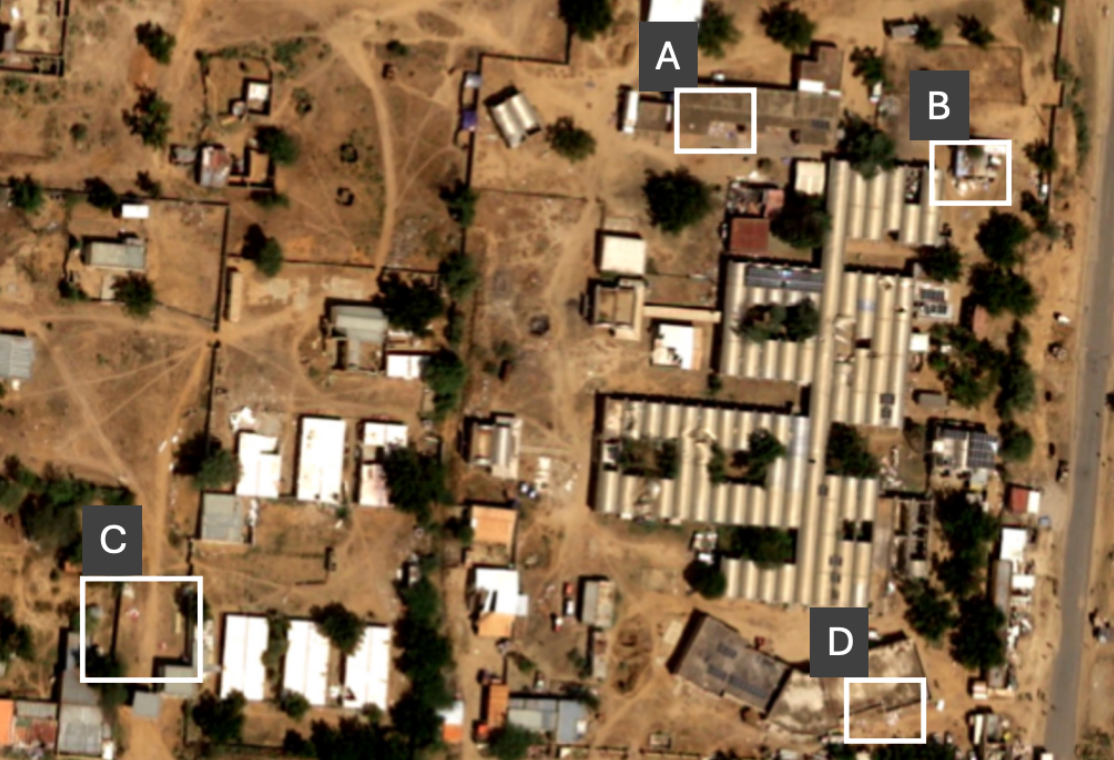
Satellite imagery collected on Tuesday showed multiple clusters of white objects similar in size and appearance to human bodies on the grounds of the Saudi Hospital. The objects are not visible in images taken the previous day.
Around two of the clusters, a “reddish discoloration” could be seen on the ground.
Similar clusters could be seen near an RSF detention centre at a former children’s hospital and outside the offices of the Red Crescent Society of Sudan.
Many of the civilians remaining in El Fasher come from ethnic groups that have historically been targeted by the RSF.
Aid workers have also been targeted by both the RSF and SAF following exchanges of territory throughout the conflict on the grounds that, by staying in that territory while it was held by the other side, they had been collaborators.
"This report... identifies potential evidence of the distinct alleged war crime of targeted attacks on health facilities, health workers, patients, and humanitarian aid workers," Yale HRL said.
"These specific, targeted attacks alleged by civil society groups and corroborated, in part, by this report demand immediate investigation and require full accountability for those who allegedly perpetrated them."
Speaking from Port Sudan on Wednesday, Minni Minawi, the Darfur regional governor and leader of a faction of the SAF-allied Sudan Liberation Movement, said that “our sons and daughters are being slaughtered” in El Fasher.
“A week ago, the RSF announced their coming massacres with full intent, they ordered their fighters not to record the crimes, hoping to bury the truth, but the truth cannot be buried. The earth itself bears witness,” he said.
‘Three young men couldn’t pay. I have no idea what happened to them.’
Speaking to Avaaz, Roua, a medical volunteer who had stayed in El Fasher throughout the war but fled last week described being stripsearched, looted, and extorted by the RSF while trying to reach Mellit, a town around 60km to the north.
“We could only travel in RSF vehicles, as they were everywhere and there were no other cars,” she said.
“We were heading to Mellit, and we were so close we could even see the minarets of the mosques there, but then the driver suddenly took a turn. He drove us into a forest off the main road and stopped the car.”
She said two RSF soldiers then set up a Starlink and demanded that all passengers transfer money or be killed.
“They told us to call our relatives to pay the ransom, but we explained that our phones had been taken and we didn’t have any numbers memorized. They didn’t care,” she said.
“They grew angry, fired shots at our feet, and took the men aside, threatening to kill them. In the end, they drove us back to Mellit at night. They started threatening us again, demanding payment. I managed to reach someone who paid for me, and most others did the same.
“Only three young men couldn’t pay. They were tied up and taken away in an RSF vehicle. I have no idea what happened to them.”
On Tuesday, an estimated 7,455 individuals were displaced from El Fasher, bringing the total number of people displaced since Sunday to 33,485, according to the International Organization for Migration.
UNHCR spokesperson Jacqueline Wilma Parlevliet said that those fleeing El Fasher have faced “armed checkpoints, extortion, arbitrary arrests, detention, looting and harassment and serious human rights violations as they tried to reach safety”.
“Testimonies from those arriving in Tawila, 50 kilometres from El Fasher, suggest that what was already an alarming humanitarian and protection crisis is spiralling rapidly,” she said.
Tawila already hosts over 650,000 displacement people, a figure that has almost tripled since March.
The MSF hospital in Tawila has received more than 400 patients, including some with trauma injuries and 70 children under five suffering from malnourishment, Sky News reports.
Voices from the Ground
Speaking to Avaaz about her escape from El Fasher, Roua, a medical volunteer, said:
“I arrived in Khartoum on 28 October 2025. It was an unbelievable journey that began with walking out of El Fasher for nine hours. We were stopped at an RSF checkpoint, where they humiliated us and searched everyone. They even forced women to remove their clothes for searches, and they beat and threatened the men with weapons. They took our phones and all our valuable belongings. It was complete suffering throughout the journey.
“We arrived in Qarni, and from there we took a donkey carriage to Turah. From Turah, we could only travel in RSF vehicles, as they were everywhere and there were no other cars. I was the only woman in the RSF car.
"We were heading to Mellit, and we were so close we could even see the minarets of the mosques there, but then the driver suddenly took a turn. At that point, there were the driver and two armed RSF soldiers in the front, and all of us were in the back. The driver said he needed to visit someone and would bring us back. He drove us into a forest off the main road and stopped the car.
“He then left us with the two armed RSF soldiers. They immediately set up their Starlink connection and ordered each of us to transfer two million Sudanese pounds or be killed. There were seven of us, and we had already paid the fees to get to Mellit. They told us to call our relatives to pay the ransom, but we explained that our phones had been taken and we didn’t have any numbers memorized. They didn’t care. Even some of our clothes and bags were looted. We had nothing left, and they refused to understand.
“They grew angry, fired shots at our feet, and took the men aside, threatening to kill them. One of the passengers remembered his family’s phone number and managed to call them; his family sent the money. The rest of us tried to convince the soldiers that we would pay once we reached our families. We pleaded for hours, from 9am to 6pm, without knowing where we were.
“In the end, they drove us back to Mellit at night. They dropped us off in a large yard just outside the city, which was full of RSF vehicles and only a valley away from Mellit. They started threatening us again, demanding payment. I managed to reach someone who paid for me, and most others did the same. Only three young men couldn’t pay. They were tied up and taken away in an RSF vehicle. I have no idea what happened to them.
“After that, I took a car to Al Dabbah and then continued to Khartoum. When I arrived, I learned what had happened in El Fasher. I left people behind, and I still have no idea what happened to them.”
The weekly dispatch features the latest developments, first-hand testimony, footage, photos, stats and analysis on Sudan. We can connect you with voices from the ground, experts and survivors of the war. I am available at +44 7514 796 678 / sudan@avaaz.org
To get this briefing in your inbox each week, sign up here.
Deploying a civilian protection mission offers the most direct path to protecting civilians and stemming atrocities in Sudan, according to a paper published Tuesday.

More than 21,000 people have been displaced by renewed fighting in Blue Nile state, according to reports, with both sides believed to be sending additional forces to the region and aid workers warning of a “catastrophic” impact for civilians.


Avaaz Foundation
110 Golden Lane | London, England, EC1Y 0TG
1330 6th Avenue, Suite 23A | New York, NY 10019, USA



.svg)


