
TUE 16 DEC – The Rapid Support Forces (RSF) is conducting a “systematic multi-week campaign” to destroy evidence of killings carried out after it took the city of El Fasher, satellite images suggest.
The latest report from the Yale Humanitarian Research Lab (HRL) identified at least 150 clusters of objects thought to be human remains as well as the burial, burning, and removal of those remains on a “mass scale”.
It added that a pattern of body disposal was "ongoing" and called on the international community and the UN to push for investigators to be given access to El Fasher while evidence of the killings is still there to be collected.
The RSF took control of El Fasher on 26 October following an 18-month siege and, in the days that followed, carried out an alleged massacre targeting the civilian population, believed to have been around 260,000 people.
The suspected body piles - spread across El Fasher and the area within a 57-km berm built around it by the RSF - were first identified in the days after the city’s fall and then monitored for changes over the following weeks.
Of the 150 identified, 108 changed size over the period, including 57 that disappeared altogether.

A total of 52 were seen in Daraja Oula, a westerly neighbourhood that became the last civilian refuge as the RSF advanced into other areas in the weeks before it took the city.
Five were in the grounds of El Fasher University, which is in Daraja Oula, while four were at the nearby Saudi Hospital.
Yale HRL said 83 were located outside El Fasher and that their distribution appeared consistent with people being killed as they fled towards possible escape routes, such as crossing points in the berm.
“The individual clusters may demonstrate instances where RSF rounded up, detained, and executed groups of people consistent with its documented behavior in this area during this period,” the report said.
Also identified were at least 20 clusters of burning objects, including at locations where suspected human remains had previously been seen, and eight areas of disturbed earth.
All but one of the burning piles and all but two of the areas of disturbed earth were in Daraja Oula.
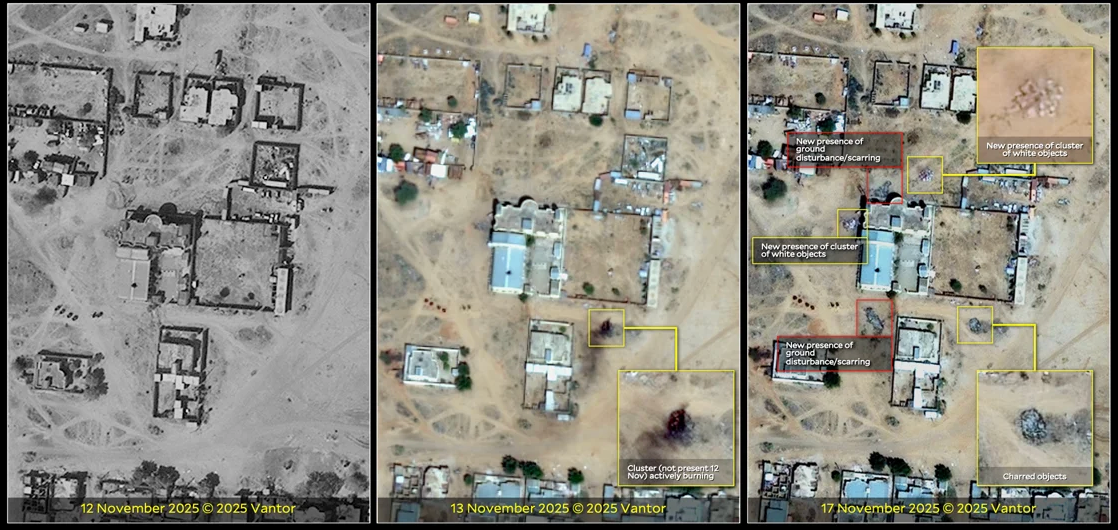
Yale HRL said seven of the areas of disturbed earth contained “no visible individuated mounds”, though added that it could not say with a high degree of confidence whether the sites were mass graves.
It added that it wasn’t yet clear what proportion of those killed were combatants or civilians, but that the “pattern of killing… can be determined as inconsistent with legitimate combat”.
The report concluded that “the international community, including the UN Security Council, must immediately secure access to El-Fasher to provide humanitarian assistance to survivors and to collect whatever evidence of the killing still remains”.
“Time is of the essence for both those still living and for the evidence left by those who have died,” it said.
Situation in El Fasher ‘horrific’ as first aid enters
Despite the huge numbers killed or displaced during and after the siege of El Fasher, between 70,000 and 100,000 civilians are still believed to be inside the city.
Earlier this month, the RSF allowed the first aid to enter the city for over a year, the New York Times reported.
Local humanitarian group Malam Darfur Peace and Development made two deliveries of food for 1,200 families.
The group said the civilians it encountered faced disastrous shortages of food, water, and medical supplies.
On Friday, Ross Smith, director of emergency response at the World Food Programme, said that the “little that's known at the moment about the current conditions in El Fasher is indeed beyond horrific”.
He said discussions with the RSF over entry to the city were ongoing but that an “agreement in principle” had been reached.
“We anticipate to be able to do that very soon, to do some initial assessments and reconnaissance.”
The Yale HRL report said any pattern of civilian life in El Fasher “seems to have all but ended” since the city fell.
It said satellite images showed markets overgrown, water points deserted, and an absence of crowds, transport, or civilian vehicles in the city's streets.
The weekly dispatch features the latest developments, first-hand testimony, footage, photos, stats and analysis on Sudan. We can connect you with voices from the ground, experts, and survivors of the war. Get in touch on +44 7514 796 678 or sudan@avaaz.org
To get this briefing in your inbox each week, sign up here.
Deploying a civilian protection mission offers the most direct path to protecting civilians and stemming atrocities in Sudan, according to a paper published Tuesday.

More than 21,000 people have been displaced by renewed fighting in Blue Nile state, according to reports, with both sides believed to be sending additional forces to the region and aid workers warning of a “catastrophic” impact for civilians.


Avaaz Foundation
110 Golden Lane | London, England, EC1Y 0TG
1330 6th Avenue, Suite 23A | New York, NY 10019, USA



.svg)


