
15 NOV 25 – An aid convoy has been destroyed in a strike in Darfur just hours after a visit to the same area by UN Humanitarian Chief Tom Fletcher.
The strike, believed to have been carried out by drone, occurred in the city of Zalinegi, capital of Central Darfur state, on Thursday.
Footage on social media showed flames and thick black smoke rising from a number of lorries, while another clip posted by the RSF showed people apparently salvaging sacks from the back of one of the vehicles.
Sources with knowledge of the convoy confirmed to Avaaz that it was carrying aid.
Earlier on Thursday, Fletcher - currently in Sudan for talks with both the Sudanese Armed Forces (SAF) and the Rapid Support Forces (RSF) about improving access for aid - said on social media that he had departed Zalingei after a visit that morning.
“We aim to open routes for more humanitarians and lifesaving supplies,” he said.
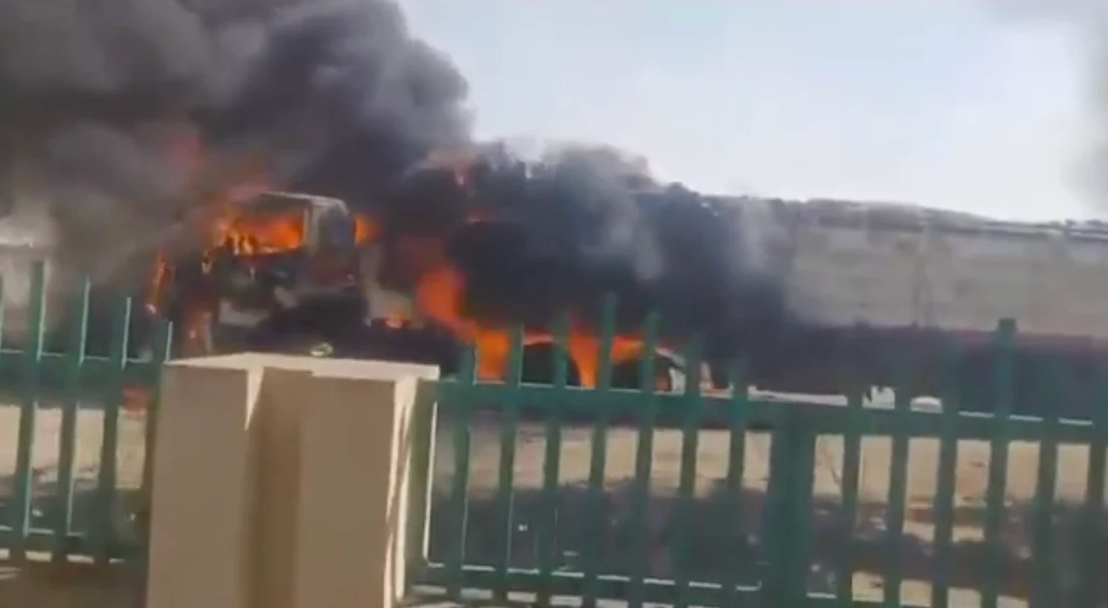
Footage online showed flames and thick smoke rising from a lorry
Recent months have seen strikes believed to have been carried out by SAF on Zalingei as well as Geneina and Nyala, the capitals of West and South Darfur.
Since the fall of El Fasher in late October, almost all of Darfur, including every state capital, has been under the control of the RSF.
In a statement on Telegram, the RSF accused SAF of destroying the convoy and said the lorries had been en route to El Fasher.
It added that it “strongly condemned” what it described as a “full-fledged war crime”.
SAF has not yet commented on the strike.
Concerns for displaced of El Fasher
Renewed attempts to get aid into North Darfur follow the mass displacement and alleged atrocities that occurred after the RSF’s capture of El Fasher.
On Thursday, the International Organization for Migration said more than 99,000 people were estimated to have been displaced from the city since it fell on 26 October.
The fall came at the end of an 18-month siege that saw the civilian population forced to eat animal feed in order to survive.
Médecins Sans Frontières said this week that its teams in the nearby Tawila displacement camp were seeing “staggering” levels of malnutrition among those arriving from El Fasher.
It said that, in the week following the fall of the city, 60% of adults and 70% of children screened at its clinics were acutely malnourished, with half those children and more than half the adults suffering severe acute malnutrition.
“We fear that many people in and around El Fasher remain stranded, held for ransom, and unable to escape,” it said.
Numerous aid groups have said the number of people arriving in displacement camps is lower than expected given the estimates of El Fasher’s civilian population.
Speaking to reporters on Wednesday, US Secretary of State Marco Rubio described the reports as “shocking”.
“These aren’t people that are happy living there after a year of siege against the city,” he said. “And we fear that the reason why they didn’t come out is because they’re dead or because they’re so sick and so famished that they can’t move.”
Asked about the role in the conflict of the United Arab Emirates (UAE), which is widely reported to be supplying the RSF, Rubio declined to reference the country by name, but said the RSF was “clearly receiving assistance from outside”.
“We know who the parties are that are involved,” Rubio said. “So I can just tell you at the highest levels of our government that case is being made and that pressure is being applied to the relevant parties. This needs to stop.”
The US and the UAE, along with Egypt and Saudi Arabia, are currently part of the so-called Quad, a forum intended to help end the conflict.
Rubio went on to accuse the RSF of agreeing to initiatives, such as a recent humanitarian ceasefire, with which “they don’t intend to comply”.
“And when you raise the issue of these atrocities, they always hide behind the argument that this is rogue elements,” he said. “Well, it’s not rogue elements. They’re doing it systematically.”
He added that the US would be open to designating the RSF a foreign terrorist organisation “if it would be helpful in bringing this to an end”.
On Friday, the UN Human Rights Council is due to hold a special session, convened by the UK and others, “on the human rights situation in and around El Fasher”.
Conflict escalates in Kordofan
Since SAF and the RSF consolidated respective control of the east and west of Sudan, the focus of the fighting has increasingly been the Kordofan region, which sits in the central south of the country.
Recent weeks have seen reports of RSF drone strikes on the SAF-controlled cities of El Obeid and Dilling as well as on the strategic Heglig oil field in West Kordofan.
The group also launched a ground assault on the city of Babanusa, site of SAF’s 22nd Infantry Division base, earlier this week, and is reportedly sending reinforcements to the area ahead of a larger offensive.
El Obeid, which until February was under a long-running siege by the RSF, is of particular strategic importance because of its size as well as its position on the main road connecting Khartoum and other eastern cities to Darfur. It is also the capital of North Kordofan state.
SAF and allied forces are currently amassing troops and equipment in the city, Reuters reports, citing eyewitnesses on the ground, while the RSF has deployed further forces near the city.
UN Human Rights Chief Volker Türk said last week that there was “no sign of de-escalation” following the fall of El Fasher.
“To the contrary, developments on the ground indicate clear preparations for intensified hostilities,” he said.
Speaking to Avaaz from El Obeid, local activist and volunteer Amani* said that “all the main roads used to bring in food and supplies are now either unstable or completely blocked” because of the conflict.
“The worst issue right now is fear,” she said. “North Kordofan has a long history of peace and was never directly involved in conflict. We only used to deal with the impact of wars happening in nearby regions like West and South Kordofan or Darfur.
“For the past two years, we’ve faced shortages in essential goods, extremely high prices, and a complete lack of electricity [after] the RSF bombed the main power station.”
In late October, hundreds of civilians were massacred after the RSF captured the town of Bara, around 60km north of El Obeid, according to the Emergency Lawyers human rights group.
Amani said there was an ongoing telecoms blackout in Bara, but that many people displaced by the attacks had been arriving in El Obeid “injured, hungry, and sick”.
She said she had heard accounts of people’s doors being broken down early in the morning, before they had even heard that SAF had withdrawn from the area.
“The RSF gathered men from each neighbourhood into public squares, checked their phones, and anyone who had previously celebrated the army’s [SAF’s] entry into Bara was executed on the spot without giving them a chance to answer,” she said.
See the Voices From The Ground segment below for Amani’s full testimony on the situation in El Obeid
Another civilian in El Obeid, Hassan*, who volunteers helping people who have arrived from Bara, said he had been told that “bodies are still lying in the streets, with no efforts made to remove or bury them”.
He said everyone arriving from Bara had been “subjected to humiliation and violence” and that many are now sleeping outdoors in El Obeid “without safety, sufficient food, or medical care”.
Amani said the Bara attacks also saw “clear cases of ethnically targeted violations” - as happened after the RSF took El Fasher - and that she feared that “if El Obeid falls, thousands will die”.
“Our message is that we don’t want the international community to respond after a catastrophe happens. We need immediate action to save lives,” she said.
Voices From The Ground
Speaking to Avaaz from El Obeid, local activist and volunteer Amani* said:
“El Obeid is currently witnessing massive waves of displacement. All the main roads used to bring in food and supplies are now either unstable or completely blocked. The RSF controls the main water sources in both the northern and southern parts of El Obeid, and residents in Al-Rahad [to the south-east] and Bara [to the north] are also severely affected.
“As community groups and local initiatives, we tried to find alternative solutions. We turned to groundwater and managed to open wells through coordination between the government, donors, and organisations.
“The worst issue right now is fear. North Kordofan has a long history of peace and was never directly involved in conflict. We only used to deal with the impact of wars happening in nearby regions like West and South Kordofan or Darfur.
“For the past two years, we’ve faced shortages in essential goods, extremely high prices, and a complete lack of electricity [after] the RSF bombed the main power station.
“Communal kitchens [takkayas] have been the main source of support for displaced families, whether in camps or hosted by relatives. They operate entirely through community donations. To this day, some still manage to provide meals with local support by donations, but there are very few NGOs present because our area is classified as a conflict zone.
“Security control over us is very tight. Whoever controls El Obeid can control the whole of Sudan because the city is extremely strategic. The road to Omdurman is close, the Darb al-Arba’in route to Aswan is nearby, the road to Benghazi, Libya, passes through the border triangle, and routes to all Sudanese states are easily accessible as well.
“Since the war began in Khartoum, we have been besieged and isolated from the world. No one reports our stories, and we’ve been completely cut off from communication networks to this day.
“The situation for women is extremely difficult. There is a huge shortage of women’s supplies, and due to the ongoing clashes and siege, there are many cases of sexual violence.
“Not all of these are committed by RSF members. The war has made rape tragically common and repeated. We even have cases of rape inside shelters.
“We also face a serious problem in El Obeid: the Humanitarian Aid Commission (HAC) is biased. It supports certain initiatives and national organisations over others and only grants approvals and work permits to those who implement its agenda.
“People from Bara have been displaced multiple times due to the fighting and siege, arriving in El Obeid in very bad condition, injured, hungry, and sick.
“Anyone trying to leave El Obeid is arrested by the RSF and sent to Bara prisons, where many detainees have died since 2023.
“The recent violations in Bara are far worse than before. According to people who reached the hospital..., the fighting began at 4am.
“Residents heard doors being broken open and thought it was SAF, but it was the RSF. The army forces had already withdrawn and all the civilians were unaware about this.
“The RSF gathered men from each neighbourhood into public squares, checked their phones, and anyone who had previously celebrated the army’s entry into Bara was executed on the spot without giving them a chance to answer.
“More than 100 people went missing on the first day. Survivors reached El Obeid, and the number continues to rise. People who came from Bara said to me there are bodies lying along the road between El Obeid and Bara. Entire families are missing, their whereabouts unknown.
“Transportation is unaffordable. The shortest trip from the centre of Bara to areas near El Obeid costs about two million Sudanese pounds, an amount no family can easily afford.
“The most dangerous issue right now is that Bara is completely cut off, with total media blackout. According to testimonies from those who arrived, many people are still trapped there. People are scattered and lost because the RSF threatens them and orders them to run or be shot. Many fled in different directions in panic.
“There are clear cases of ethnically targeted violations. Our message is that we don’t want the international community to respond after a catastrophe happens. We need immediate action to save lives. If El Obeid falls, thousands will die immediately.
“Stop the war, stop supporting the war, and please prevent RSF from advancing here. We need strong international pressure on those supporting the war in Sudan to end their involvement.”
*Names changed due to security concerns.
The weekly dispatch features the latest developments, first-hand testimony, footage, photos, stats and analysis on Sudan. We can connect you with voices from the ground, experts and survivors of the war. I am available at +44 7514 796 678 / sudan@avaaz.org.
To get this briefing in your inbox each week, sign up here.
Deploying a civilian protection mission offers the most direct path to protecting civilians and stemming atrocities in Sudan, according to a paper published Tuesday.

More than 21,000 people have been displaced by renewed fighting in Blue Nile state, according to reports, with both sides believed to be sending additional forces to the region and aid workers warning of a “catastrophic” impact for civilians.


Avaaz Foundation
110 Golden Lane | London, England, EC1Y 0TG
1330 6th Avenue, Suite 23A | New York, NY 10019, USA



.svg)


