
THU 10 JUL – Thousands of villagers are being displaced as the Rapid Support Forces (RSF) targets a key city in North Kordofan, with one describing the group “terrorising” civilians and killing them if they try to resist.
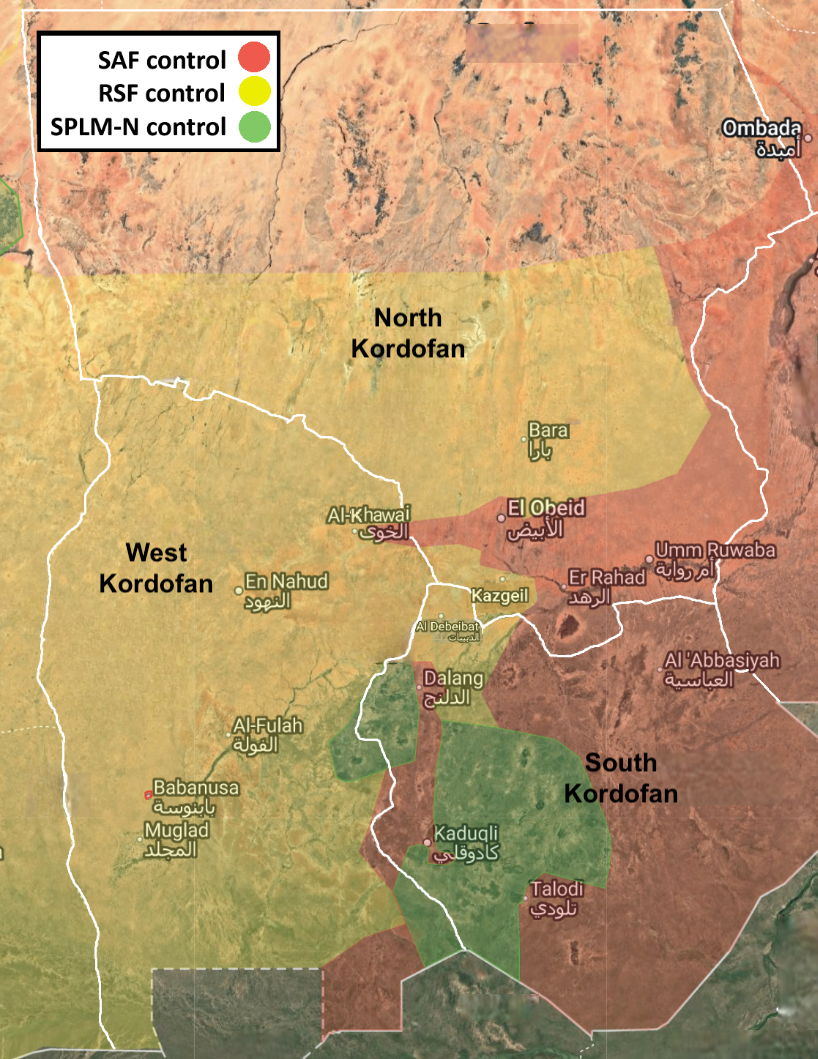
State capital El Obeid, home to over 500,000 people, is the site of a Sudanese Armed Forces (SAF) military garrison and sits on an important highway that runs across Sudan.
Recent months have seen intense fighting and frequent shelling of the city as the RSF, which controls much of the surrounding area, tries to reimpose a siege that was lifted in February.
Amira, a woman from a village near the town of Kazgeil, around 50km south of El Obeid, told Avaaz that RSF fighters first began launching attacks in the area on 16 June.
“They killed young men in… villages around us. Then they came twice and told us to leave,” she said. “The young men who wanted to protect us were killed. The RSF killed six young men in my village, and we had to leave. They came on motorbikes and started terrorising people.”
Control of Kazgeil, which has changed hands multiple times over the last few weeks, would help SAF maintain supply lines to its forces in El Obeid.
Amira said she and a group of around 20 families that included pregnant women and children were forced to flee for El Obeid, arriving after two days’ travel.
“We slept on the road and starved on the way,” she said. “We would sometimes eat tree leaves. We have nothing now—not even tents or linoleum to protect us from the rain. Our children are going to die from hunger and cold."
A second woman, Hawa, a teacher from near the town of Al-Debeibat in South Kordofan, described leaving for El Obeid on a tractor that was so overcrowded, and moving so fast, that one young girl fell to the ground and suffered a fatal head injury.
Hawa said she spent three days on the road with no food or water and is now staying with family, though adds that houses in the city are “overflowing” with people displaced from across the region.
“Everyone is already hosting many people. You often end up just sleeping on the floor,” she said.
See the Voices From The Ground segment below for Amira and Hawa’s full testimonies
A state official told the Sudan Tribune that hundreds of families had arrived in El Obeid after being displaced by RSF attacks over recent weeks. Figures from the International Organization for Migration (IOM) show that, since 24 June, approximately 4,240 households have been displaced from villages around El Obeid or the Bara district to its north.
The highway on which El Obeid sits runs from Sudanese capital Khartoum, through the Kordofan region, and on to Darfur in the west. Fighting in North Kordofan and West Kordofan states has particularly escalated since SAF retook Khartoum in March.
The RSF hopes to gain territory in the region to create a buffer zone between SAF areas and Darfur, almost all of which it currently controls. In a video address in early June, RSF leader Hemedti told SAF: “If you think of using El Obeid as a launchpad to bomb Darfur and Kordofan, we will come to you. Our force is ready to move at any time.”
The attacks on areas around El Obeid fit a pattern seen in other areas in which the RSF has sought to capture territory. After imposing the ongoing siege on North Darfur capital El Fasher in April 2024, the group began razing and burning civilian homes in the surrounding area, as documented in satellite imagery gathered by the Yale Humanitarian Research Lab.
Adding to the situation in El Obeid is a growing cholera outbreak. Mohamed Ismail, North Darfur’s Commissioner for Humanitarian Aid, has confirmed more than 80 cases and four deaths recorded in the city, the Sudan Tribune reports. He said health workers were being prevented from travelling to affected villages in RSF-controlled areas and called for them to be given full access.
Across Sudan, more than 32,000 suspected cholera cases have been reported so far this year, according to the UN.
In a report released yesterday, Mercy Corps described a "devastating yet overlooked humanitarian catastrophe" unfolding in Kordofan.
Mercy Corps Country Director for Sudan, Kadry Furany, said: "Conflict, displacement, and economic collapse are converging to devastate Kordofan.
"In Kadugli, the capital of South Kordofan, our team describes a city under siege. Roads have been cut off, supply lines have collapsed, and residents are walking miles just to search for salt or matches. The little food available is sold at exorbitant prices, rationed in small quantities, and often vanishes within hours.
"Families fleeing violence are sheltering in open fields, stadiums and schools around Kadugli. Aid workers on the ground are struggling to meet the most basic needs. Our team warns that health services have all but collapsed. If someone falls ill, there may be no medicine—another crisis on top of starvation."
People in El Fasher ‘experiencing agony’
In El Fasher, the siege continues to have devastating consequences for the civilian population. As we’ve reported over recent weeks, very few supplies are entering the city, causing widespread malnutrition and a collapse in basic services.
One person in the city told Avaaz the situation was “extremely dangerous due to intensive shelling”. He added that people were “experiencing all sorts of suffering and agony, starvation”.
Between 26 June and 6 July, an estimated 647 households were displaced from El Fasher and the adjacent Abu Shouk camp because of the security and humanitarian situation, according to the IOM.
Last week, a bid by the World Food Programme to send aid to the city was rejected by the Sudan Liberation Movement-Transitional Council, which shares control of parts of Darfur with the RSF. The group said the majority of the civilian population had already fled and labelled El Fasher a “military operations zone”.
A source with knowledge of the situation on the ground said there was a significant military presence but that up to one million civilians were believed to still be in El Fasher.
In a statement, the UN’s humanitarian chief, Tom Fletcher, said civilians in the city were “cut off from aid and at risk of starvation”.
“Every day without access costs lives,” he said. “I’ve held a series of calls this week on an urgent humanitarian pause. Let us work.”
A Médicins Sans Frontières (MSF) report released last week describes indiscriminate and ethically-motivated violence against civilians, the targeting of civilian infrastructure like water pumps, and the shelling of health facilities. The report documents the human rights abuses and deterioration in conditions in El Fasher from May 2024 to May 2025. It says an assessment in March found that 38% of children under five in the city were suffering from acute malnutrition. Read the full report here.
Voices from the Ground
Testimony taken Wednesday 9th July. Interviews available on request. Names have been changed due to safety concerns.
Amira, a civilian from a small village east of Kazgeil, North Kordofan, told Avaaz:
“I just fled from my village after the RSF entered. They started attacking the villages around us on June 16, 2025. They killed young men in Al-Soghor and Eid Alnimir villages around us. Then they came twice and told us to leave. The young men who wanted to protect us were killed. The RSF killed six young men in my village, and we had to leave. They came on motorcycles and started terrorizing people.
“We had to leave—even the birds fled with us. We left everything behind and took only our donkeys for the road. We spent two days on the road. There were around 20 families fleeing together: mothers, pregnant women, children, and older men.
“The journey was very difficult. First we went to Hilat Salih, then to El-Ban Jadeed, then to Tenga, and finally to El-Obeid. We slept on the road and starved on the way. We would sometimes eat tree leaves.
“We have nothing now, staying in El-Obeid. We have nothing—not even tents or linoleum to protect us from the rain. Our children are going to die from hunger and cold. No one cares about us or even remembers to help us."
Hawa, a teacher from a village near Al-Debeibat, South Kordofan, told Avaaz:
“After the RSF entered Al-Debeibat, they started attacking the surrounding villages, so we fled last week on a tractor. The tractor was overflowing with people—so overcrowded that one young girl fell off, broke her skull, and died immediately.
“We were a large group of people and had to use three tractors. The RSF attacked us viciously with heavy weaponry, forcing us to flee. We spent three days on the road, and it was a very difficult journey. There was no food or water, and it was very crowded because everyone wanted to escape. The drivers were driving very fast, which is why we lost that little girl. She was a student—I know this because I am a teacher back in my village.
“We were completely exhausted when we arrived here in El-Obeid. We are now staying with family members, as there are no displacement camps here. We have to rely on family and friends, which is very difficult because everyone is already hosting many people. You often end up just sleeping on the floor.
“The people who tried to resist the RSF back home were killed. We left everything behind—most of us are farmers and had to abandon our crops. We found many other displaced people in El-Obeid, from Kazgeil, Al-Debeibat, Al-Nuhud, and Al-Khiwai. We are all staying with people we know here, and the houses are overflowing with displaced people.”
The weekly dispatch features the latest developments, first-hand testimony, footage, photos, stats and analysis on Sudan. We can connect you with voices from the ground, experts and survivors of the war. Please contact +44 7935 296 004 / sudan@avaaz.org.
To get this briefing in your inbox each week, sign up here.
Deploying a civilian protection mission offers the most direct path to protecting civilians and stemming atrocities in Sudan, according to a paper published Tuesday.

More than 21,000 people have been displaced by renewed fighting in Blue Nile state, according to reports, with both sides believed to be sending additional forces to the region and aid workers warning of a “catastrophic” impact for civilians.


Avaaz Foundation
110 Golden Lane | London, England, EC1Y 0TG
1330 6th Avenue, Suite 23A | New York, NY 10019, USA



.svg)


