
FRI NOV 7 -- The UAE-backed Rapid Support Forces (RSF) have shut down one of the last remaining escape routes out of El-Fasher, and appear to be burning bodies at several sites across the city, according to a new report.
At the same time, the RSF on Thursday announced it had agreed to a humanitarian truce proposed by US-led mediators, saying it "looks forward to implementing the agreement and immediately commencing discussions on arrangements for a cessation of hostilities."
Will Davies, Campaign Director at Avaaz, said: "There are still an estimated 200,000 civilians in El Fasher and the RSF just sealed off their escape route, and appears to be burning piles of bodies it has slaughtered.
“It’s clear the RSF's commitment to peace in Sudan is not rooted in reality. If lives are to be spared, the RSF must be compelled to stop their slaughter via serious economic pressure on its main backer, the UAE."
By the time of the RSF's capture of El Fasher on October 26, it had completed its months-long construction of an earthen wall, or 'berm', which effectively sealed off the city bar a handful of exit points.
Satellite imagery analyzed by the Yale School of Public Health’s Humanitarian Research Lab shows that between November 2 and 4, RSF fighters blocked a key berm crossing at the Garni Gate, an earthen-walled passage that had been used by civilians fleeing months of siege and violence.
By November 4, the images show that earth had been pushed across the berm from both sides, effectively sealing the road and trapping thousands of people inside the city.
“This action likely closes one of the last major exit points for civilians attempting to escape El-Fasher,” the report said. Tens of thousands of civilians have been slaughtered in El Fasher over the past 10 days.
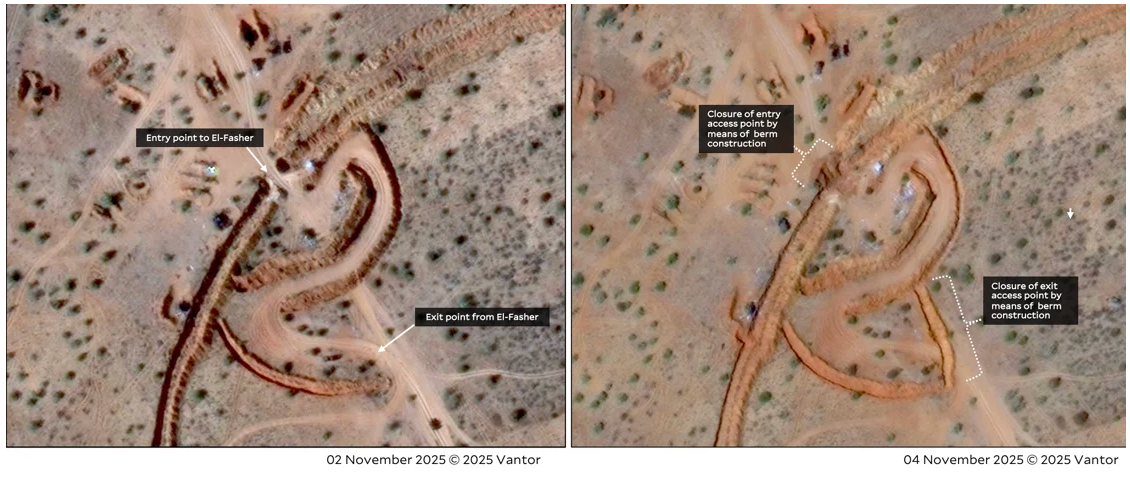
Satellite imagery from Garni Gate, El-Fasher shows closure of berm between 02-04 November © 2025, Vantor
Evidence of Burned Bodies
New satellite imagery collected on November 6 also appears to show the burning of objects that may be consistent with human remains at two RSF-controlled sites: Mellit Gate, on the northern edge of the city, and the grounds of Saudi Hospital, where a mass killing was previously documented.
White, oblong shapes near the main hospital buildings are seen on November 1. By November 6, those shapes appeared charred, with black smoke visible above the site. Yale HRL said their size and arrangement were consistent with human bodies.
“This activity may be consistent with the burning of bodies and other forms of body disposal,” the lab reported, noting that such practices contradict Islamic burial traditions and complicates any future effort to count the number of people killed since the fall of El-Fasher and to identify and return the remains to family members.
Yale’s researchers first identified objects with human-like dimensions outside Saudi Hospital on October 28. Subsequent imagery showed those objects had been removed, when flatbed trucks were seen near the site. As many as 460 people were executed at the hospital after RSF forces seized control of El-Fasher.
At Mellit Gate, satellite images taken between October 30 and November 6 show a similar pattern: clusters of objects that appear stationary in earlier images are later seen burning. The RSF has maintained strict control of the area since June, when the berm crossing was constructed and fortified with earthen barriers.
Survivors arriving in Tawila have repeatedly reported that RSF has executed people at berms and when crossing, including separating out groups of people, often specifically men, and executing or disappearing them. "This activity may be consistent with burning bodies and other forms of body disposal," the report adds.
At the former Children’s Hospital, satellite images show that dark and light-toned objects visible on November 3 had been cleared by November 6. The lab said the changes suggest the area was leveled, possibly by earth-moving equipment, to conceal evidence of at least two potential mass killings on the grounds.
ENDS
Testimonies from those who fled El Fasher, in the form of voice notes and transcribed text, are available upon request.
Contact: sudan@avaaz.org for more information or interview requests.
Deploying a civilian protection mission offers the most direct path to protecting civilians and stemming atrocities in Sudan, according to a paper published Tuesday.

More than 21,000 people have been displaced by renewed fighting in Blue Nile state, according to reports, with both sides believed to be sending additional forces to the region and aid workers warning of a “catastrophic” impact for civilians.


Avaaz Foundation
110 Golden Lane | London, England, EC1Y 0TG
1330 6th Avenue, Suite 23A | New York, NY 10019, USA



.svg)


