
FRI 15 AUG – Life in the besieged city of Kadugli has become “unbearable“, a local aid worker has said, with hunger widespread and clinics facing lethal shortages of medical supplies.
The city, the capital of South Kordofan, is controlled by the Sudanese Armed Forces (SAF) but is under a long-running siege by the Sudan People's Liberation Movement-North (SPLM-N), an ally of the Rapid Support Forces (RSF).
Between them, the SPLM-N and RSF hold much of the surrounding territory, with humanitarian access all but cut off.
Speaking to Avaaz from Kadugli, aid worker Rashid said the city was in the grip of an “unprecedented humanitarian disaster”.
“We are surrounded by hunger, disease, and total isolation,” he said. “The situation is worse than anything we’ve seen in decades. Nothing gets in or out. We are alone. This city is dying slowly.”
He said a communal kitchen was still able to cook one meal a day for around 500 people, but added: “That’s all we can do. The rest go hungry.”
Footage sent to Avaaz last week showed scores of children and teenagers queuing with empty bowls while a man at the front of the line served portions of balila (boiled chickpeas) from a large white tub.
“Prices in the market are beyond comprehension,” Rashid said. “A kilo of flour reached 40,000 pounds [$67] last week and today is not available at all. Even the wealthy can no longer afford to live here.
“Even water is a struggle. With fuel prices this high, most people can’t afford to pump clean water anymore. Rainwater is our main source of drinking water now.”
Rashid described the state of medical care in Kadugli as “catastrophic”, saying that hospitals now have “nothing”.
“No malaria medication, no antibiotics, no painkillers, no anesthesia, no gauze, no oxygen,” he said. “Not a single vial of tetanus or rabies antiserum. Snake bites and infections go untreated. Children’s vaccines? All six of the essential childhood immunizations are completely unavailable.
“People are dying quietly, unseen. Tuberculosis is spreading again. Night blindness [a symptom of vitamin A deficiency] is on the rise. There’s a dangerous shortage in blood supplies, and some health departments have simply closed their doors.”
Last week, at least three children in Kadugli died from complications of malnutrition, while three other people died after missing kidney dialysis sessions at Kadugli Hospital, Sudan Tribune reports.
In a statement, the Sudan Doctors Network told the outlet that the “continued siege and lack of food and treatment… has caused malnutrition to spread significantly among children, women, and the elderly”.
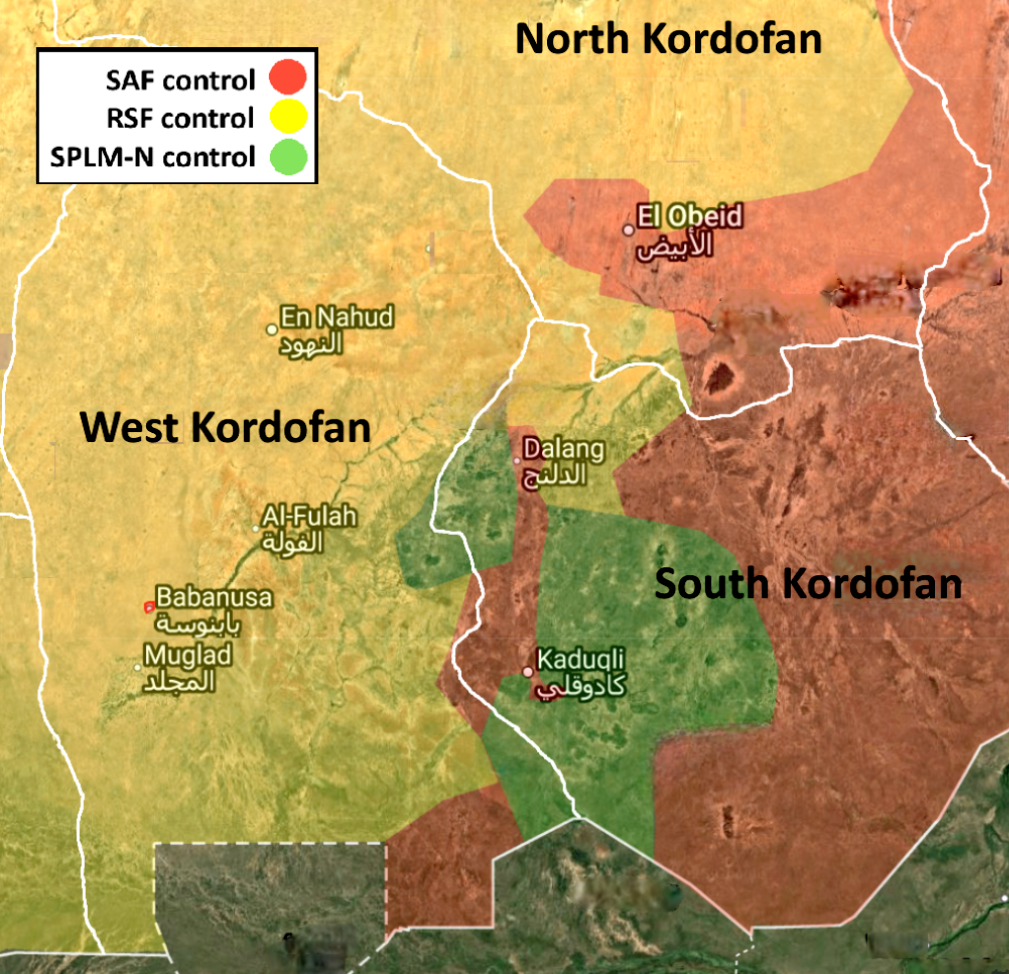
Since SAF retook Sudanese capital Khartoum from the RSF in March, the Kordofan region - which sits in the central south of Sudan and comprises North, West, and South Kordofan states - has become the major battleground in the broader conflict.
Kadugli has been under at least partial siege since the early months of the war, but conditions in the city have deteriorated since April, when the RSF attacked and ultimately took Nahud, a key city in neighbouring West Kordofan state.
The fall of Nahud, and other clashes in the region, cut Kadugli off from a number of towns along the supply routes for food into the city.
SAF retains control of Dalang, around 70 miles to the north, but the town is suffering its own humanitarian crisis, and fighting in the region makes travel back and forth to Kadugli extremely difficult.
Between 6 and 10 August, more than 3,000 people were displaced from Kadugli because of “conflict which severely worsened economic conditions and led to shortages of vital goods”, according to the International Organization for Migration.
The UN said this week that humanitarian access to Kadugli remained “extremely limited, as the primary supply route is inaccessible due to active hostilities, making road access virtually nonexistent”.
SAF ‘confiscates everything entering the city’
The SAF authorities have also faced allegations of restricting the supply of food inside Kadugli.
In April, SAF suspended the permissions of more than 30 humanitarian organisations, including international groups like the Norwegian Refugee Council, to operate in the city.
A government source told Radio Dabanga the move followed a dispute between one aid organisation and a local official who wanted to control the distribution of aid tokens.
The authorities have also been accused of withholding aid delivered by the World Food Programme over the last two years and now held in storehouses, Atar reports.
SAF is thought to want to control the supply of food in order to prevent supplies reaching areas held by opposition forces. It also routinely targets civil society and community aid workers with arrest and intimidation in the areas it controls.
One Kadugli resident told the Sudanese Women’s Rights Action (SUWRA) group that SAF “confiscates all items entering the city”.
“Food vendors are reluctant to sell during daytime hours due to safety concerns, resulting in nighttime transactions. Transporting or selling food within the city has become increasingly hazardous,” they said.
Market traders are also believed to have exploited the crisis by hoarding goods and further increasing prices, according to Atar.
Earlier this month, 15 women were arrested for staging a protest near the local branch of the Central Bank of Sudan calling on the authorities to release more aid, Atar reports.
It followed a gunfight that broke out on 21 July between SAF and Kafi Tayyar, an armed group normally allied with SAF, after members of Kafi Tayyar broke open warehouses and shops at a Kadugli market and told an assembled crowd to take what they needed. The incident reportedly left at least 10 civilians killed or wounded.
The same day, at least eight women were detained for taking part in protests calling on SAF to release more food, according to SUWRA. A 16-year-old girl was earlier detained for trying to take photos of long lines of people queuing at a market.
Voices from the Ground
Interviews available on request. Names have been changed due to safety concerns.
Rashid, a local aid worker in besieged Kadugli, told Avaaz:
“Life in Kadugli has become unbearable. The city is gripped by an unprecedented humanitarian disaster. We are surrounded by hunger, disease, and total isolation. The situation is worse than anything we’ve seen in decades. The city is under siege, and nothing gets in or out. Travel is impossible except to Dalang [a city around 70 miles to the north that is also under SAF control], and even that is uncertain.
“There are no humanitarian organizations operating here. None. We, the people of Kadugli, are the only ones helping each other. We’ve managed to set up a simple communal kitchen. Every day, we cook one meal — just balila — for around 500 people. That’s all we can do. The rest go hungry.
“Around three quarters of the people in this city survive on a single meal per day. Not a proper meal — just a small portion of balila (boiled chickpeas), or dry kisra (flatbread) with water and salt, or a watery porridge mixed with sesame. [Many] families now rely on wild herbs, grasses, and leaves from trees as their main source of food.
“Prices in the market are beyond comprehension. A kilo of flour reached 40,000 pounds [$67] last week and today is not available at all. Lentils are 60,000. A pound of cooking oil, when available at all, goes for 25,000. Diesel and benzene? Each gallon costs 250,000 pounds. Even the wealthy can no longer afford to live here. You might stand in line for hours just to get a malwa [a local measure] of sorghum flour for 30,000 pounds — and still return home empty-handed. There is no sugar, no spices, no matches. Tea is 60,000 pounds a pound. Coffee? 80,000.
“The central market of Kadugli is dead. [The vast majority] of the shops are shuttered, most of them looted [when Kafi Tayyar gunmen opened the stores and told people to take what they needed]. More than 200 shops were completely emptied in a single day. There’s no cash, no goods, and no hope in that place anymore.
“The health situation is catastrophic. Hospitals and clinics have nothing. No malaria medication, no antibiotics, no painkillers, no anesthesia, no gauze, no oxygen. Not a single vial of tetanus or rabies antiserum. Snake bites and infections go untreated. Children’s vaccines? All six of the essential childhood immunizations are completely unavailable.
“People are dying quietly, unseen. Tuberculosis is spreading again. Night blindness [a symptom of vitamin A deficiency] is on the rise. There’s a dangerous shortage in blood supplies, and some health departments have simply closed their doors.
“Even water is a struggle. With fuel prices this high, most people can’t afford to pump clean water anymore. Rainwater is our main source of drinking water now. The cost of grinding grain is so high that many have stopped altogether. That’s why we eat balila — it’s all we can manage.
“There are no proper communications left. Only Starlink devices are still working. The rest — all mobile networks — have gone silent.
“The catastrophe began around April this year, after military operations disrupted the trade routes through Um Adara and Barno [villages on the border between West and South Kordofan]. Those towns were lifelines — they connected us to the market in Sooq Al Naeem [on the South Sudanese border]. Then the RSF entered Nahud, cutting off the flow of goods from the Northern State through Al Dabbah, Nahud, and El Fula. Since then, Kadugli has been left to starve.
“We are alone. This city is dying slowly, and no one is even paying attention.”
The weekly dispatch features the latest developments, first-hand testimony, footage, photos, stats and analysis on Sudan. We can connect you with voices from the ground, experts and survivors of the war. I am available at +44 7935 296 004 / sudan@avaaz.org
To get this briefing in your inbox each week, sign up here.
Deploying a civilian protection mission offers the most direct path to protecting civilians and stemming atrocities in Sudan, according to a paper published Tuesday.

More than 21,000 people have been displaced by renewed fighting in Blue Nile state, according to reports, with both sides believed to be sending additional forces to the region and aid workers warning of a “catastrophic” impact for civilians.


Avaaz Foundation
110 Golden Lane | London, England, EC1Y 0TG
1330 6th Avenue, Suite 23A | New York, NY 10019, USA



.svg)


