
FRI 26 SEPT -- The largest displacement camp in besieged El Fasher is almost completely empty of civilians after being attacked and taken over by the Rapid Support Forces (RSF), Avaaz has been told.
The Abu Shouk camp, on the northern edge of El Fasher, was formerly one of the main population centres for the estimated 260,000 people still in the city.
Recent weeks have seen the RSF gain control of the camp following a large-scale assault that forced the Sudanese Armed Forces (SAF) to retreat to the city’s centre and west.
Speaking to Avaaz from El Fasher, local aid worker Yousif said Abu Shouk was “now almost entirely empty of civilians”.
“The displaced people who were there have been forced to leave due to lack of food and security,” he said.
“RSF forces repeatedly enter the camp, and now the camp has become a hub of weapons and RSF vehicles, making it extremely unsafe.”
Multiple sources confirmed to Avaaz that almost all civilians have now left Abu Shouk.
Yousif said most had fled to the sprawling camps around Tawila, around 50km to the west, or to villages in the surrounding area, though added that the road to Tawila remained the “worst possible escape route”.
“Looting, assaults, and if they decide to detain us, they can arrest us and demand our family continue fleeing without us.
“We have lost many people this way, some civilians are released only after paying extremely high ransoms."
Between 17 and 19 September, at the height of the RSF assault, at least 7,500 people were displaced from Abu Shouk, according to the International Organisation for Migration. It is not clear how many civilians were still in Abu Shouk before the assault. On Tuesday and Wednesday, a further 1,640 people were reportedly displaced within El Fasher.
Satellite images gathered by the Yale Humanitarian Research Lab over recent months showed the RSF has built 65km of earthen walls around El Fasher, allowing it to control the flow of people and supplies to and from the city.
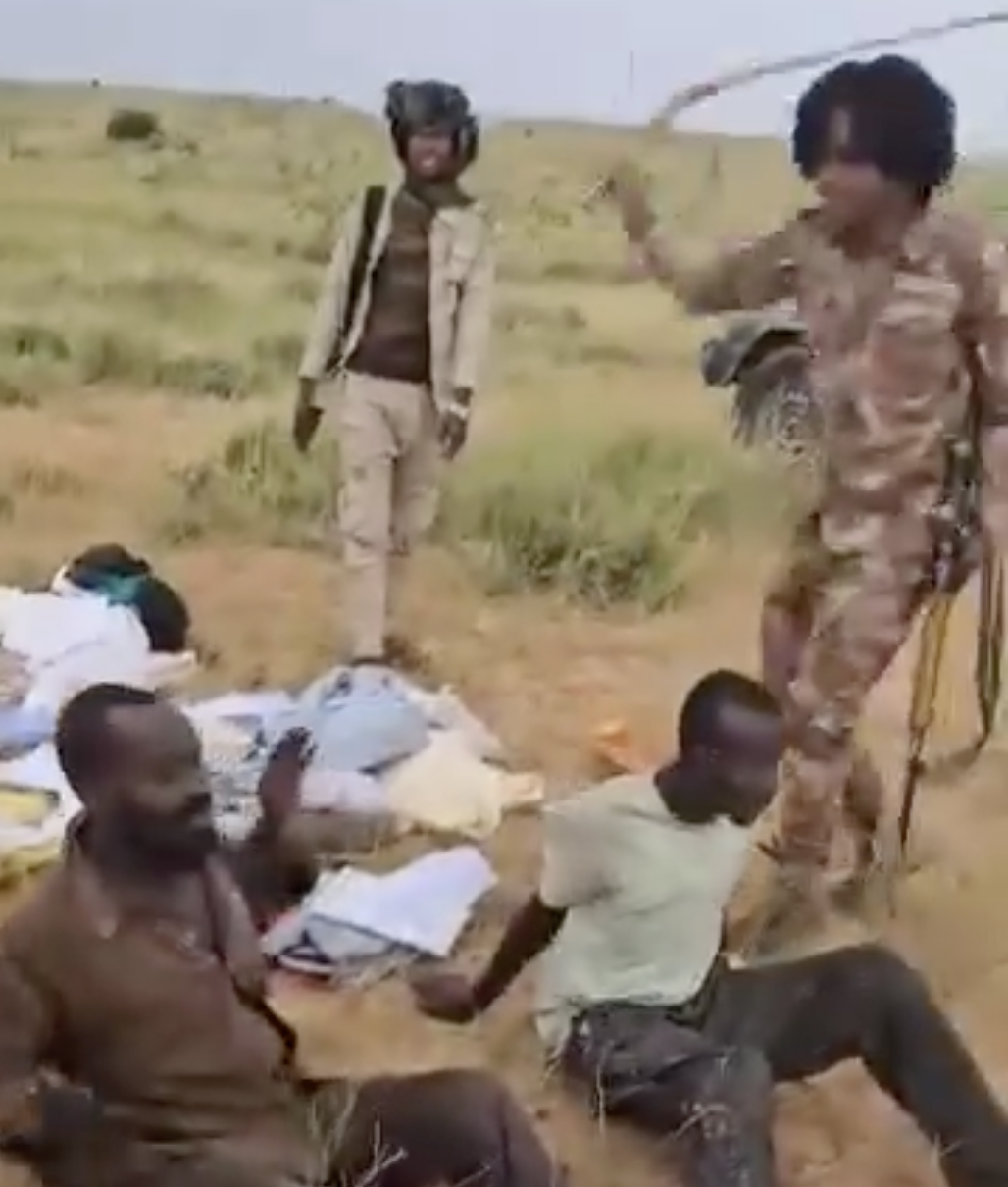
Footage sent to Avaaz this week shows numerous young men being interrogated and tortured by the RSF after being caught trying to flee.
In one clip, believed to have been shot on Wednesday, two men are seen being hit with a bullwhip and forced to drink a liquid from a jar.
One soldier asks: “Why are you sitting with the army [SAF] inside El Fasher and eating ambaz, you dog?”
In recent months, the shortage of food entering El Fasher has forced many to resort to eating ambaz, a mixture made of peanut shells and usually fed to animals.
One of the men replies, “I ate ambaz because I was hungry”, to which the soldier says: “You should eat poison”.
A soldier is also seen tearing a set of prayer beads from the neck of one of the men. Both men are then ordered to empty their pockets.
In a second clip, believed to have been shot on Thursday, more than a dozen men are seen walking in front of three others on camels as RSF soldiers approach on motorbikes.
The camel herders are believed to be from an Arab group supportive of the RSF.
One of the RSF soldiers is heard telling the men to “sit down, you falnagayat”, a local term for someone loyal to SAF.
The men are then interrogated about the situation in El Fasher. Asked whether they would like to send a message to their “brothers inside El Fasher”, they reply that those still in the city should surrender and leave. One of the soldiers then repeats: “Those inside El Fasher must surrender and leave.”
The source who sent the videos to Avaaz reported that the men were being held for a ransom equivalent to $25,000 each.
On Tuesday, at least 27 people were killed or injured in a drone strike on an El Fasher market busy with civilians, according to the local Coordination of Resistance Committees.
The strike took place in the Darja Awlaa and killed 16 people in total, according to reports.
In graphic aerial footage reportedly showing the strike, civilians are seen walking amid a collection of small buildings beside a road.
Black smoke then billows from an explosion in the centre of the area and, as it clears, numerous people are seen lying on the ground, some of them unconscious, some visibly unable to stand because of wounds to their legs.
It followed the deaths of more than 70 civilians in a strike on a mosque in the same neighbourhood during dawn prayers on Friday last week. Both strikes are believed to have been carried out by the RSF.
Yousif said the drone strikes had made the situation for people living under the siege of El Fasher even more difficult.
“What used to be random stray bullets or indiscriminate shelling has now shifted,” he said.
“The RSF has become very precise in targeting, and it is us, the civilians, who are the targets. Any gathering is attacked. People live in fear, terror, and hunger.”
The resistance committee said Tuesday’s strike was the “latest in a series of countless massacres carried out systematically and escalating daily by the militias in an attempt to bring the resilient city to its knees and break the will of its residents”.
Interviews available on request. Names have been changed due to safety concerns.
Speaking to Avaaz on Thursday, local aid worker Yousif said:
“Last week in El Fasher was one of the worst days of our lives. Drone strikes come without any set time or place, from all directions. Any gathering of people or moving vehicles have been targeted.
“The impact of the drones on our lives is that they have increased our terror and fear, and further complicated the security situation in El Fasher. Right now, the security situation is completely unstable.
“In Abu Shouk camp, unfortunately, the camp is now almost entirely empty of civilians and the displaced people who were there have been forced to leave due to lack of food and security.
“RSF forces repeatedly enter the camp, and now the camp has become a hub of weapons and RSF vehicles, making it extremely unsafe. Most of the displaced have gone to Tawila and to several neighbourhoods and villages in North Darfur.
“Currently, the road from El Fasher to Tawila is the worst possible escape route: looting, assaults, and if they decide to detain us, they can arrest us and demand our family continue fleeing without us. We have lost many people this way, some civilians are released only after paying extremely high ransoms.
“Food availability is extremely dire. [At the community kitchen], we may receive just one small sheep for 5 million Sudanese pounds, meant to feed hundreds of families. In the past, our budget covered 15 days, now it only allows meals for three to six days.
“Prices have skyrocketed, and there is a shortage of food and all basic supplies for eating and drinking. For water, we just rely on collecting rainwater.
“The markets are completely empty. Even the last market that was still functioning recently, Nevasha Market, has now shut down due to fighting nearby, along with drones constantly circling over El Fasher.
“Our security situation is extremely difficult. What used to be random stray bullets or indiscriminate shelling has now shifted. RSF has become very precise in targeting, and it is us, the civilians, who are the targets. Any gathering is attacked. People live in fear, terror, and hunger.
“Access to the internet [usually done at local hubs] has become very hard, because of our fear of drones. This also means our news does not reach the world, and we know about our families abroad only two or three days later.
“I mourn the lives we have lost, and we hope the war will end as soon as possible. We call on the international community and human rights organizations to do everything possible to provide safe corridors to evacuate civilians who want to leave safely and unharmed.
“As for a military defeat, from what we see, it has become impossible. Civilians who still hope for a breaking of the siege of El Fasher don’t know when that could ever happen. But we urge citizens to take care of their young children, to raise and support them, even amid disease, hunger, and death everywhere. We pray that international actors will save them.
“We demand the opening of safe corridors for aid delivery, even if it requires UN forces, since the two warring parties have no trust between them.”
FOOTAGE & IMAGES
The weekly dispatch features the latest developments, first-hand testimony, footage, photos, stats and analysis on Sudan. We can connect you with voices from the ground, experts and survivors of the war. I am available at +44 7514 796 678 / sudan@avaaz.org
To get this briefing in your inbox each week, sign up here.
Deploying a civilian protection mission offers the most direct path to protecting civilians and stemming atrocities in Sudan, according to a paper published Tuesday.

More than 21,000 people have been displaced by renewed fighting in Blue Nile state, according to reports, with both sides believed to be sending additional forces to the region and aid workers warning of a “catastrophic” impact for civilians.


Avaaz Foundation
110 Golden Lane | London, England, EC1Y 0TG
1330 6th Avenue, Suite 23A | New York, NY 10019, USA



.svg)


