
TUE 20 JAN – Civilians fleeing the besieged city of Kadugli risk being extorted, ethnically targeted, and killed, according to one who has escaped the city, while those still trapped face hunger, soaring prices, and a critical lack of medical supplies.
Kadugli is one of three cities in the Kordofan region - along with Dilling and El Obeid to its north - currently held by the Sudanese Armed Forces (SAF) but being targeted by the allied Rapid Support Forces (RSF) and Sudan People’s Liberation Movement-North (SPLM-N).
Kordofan, which sits in the central south of Sudan, has become the epicentre of the conflict over recent months, and capturing its major cities would be a significant step for the RSF as it seeks to expand its territorial control.
Kadugli and Dilling remain under long-running sieges and cut off from one another, with famine having been declared in Kadugli and believed to be present in Dilling.
Speaking to Avaaz, Hanaan*, who fled Kadugli for El Obeid earlier this month, said she and 14 relatives decided to leave after a number of recent RSF gains in the region that “destroyed our sense of safety”.
“People began to feel that Kadugli would be the next target…, and the strongest feeling among civilians is fear. Mass displacement began in all directions,” she said.
“It was a very difficult decision. Many families who left before us were arrested by the RSF or SPLM-N. They detain people and prevent them from traveling.”
An estimated 1,765 have been displaced from Kadugli just since 31 December, according to the International Organization for Migration (IOM). It follows an estimated 64,890 displaced across Kordofan in the final 10 weeks of last year.
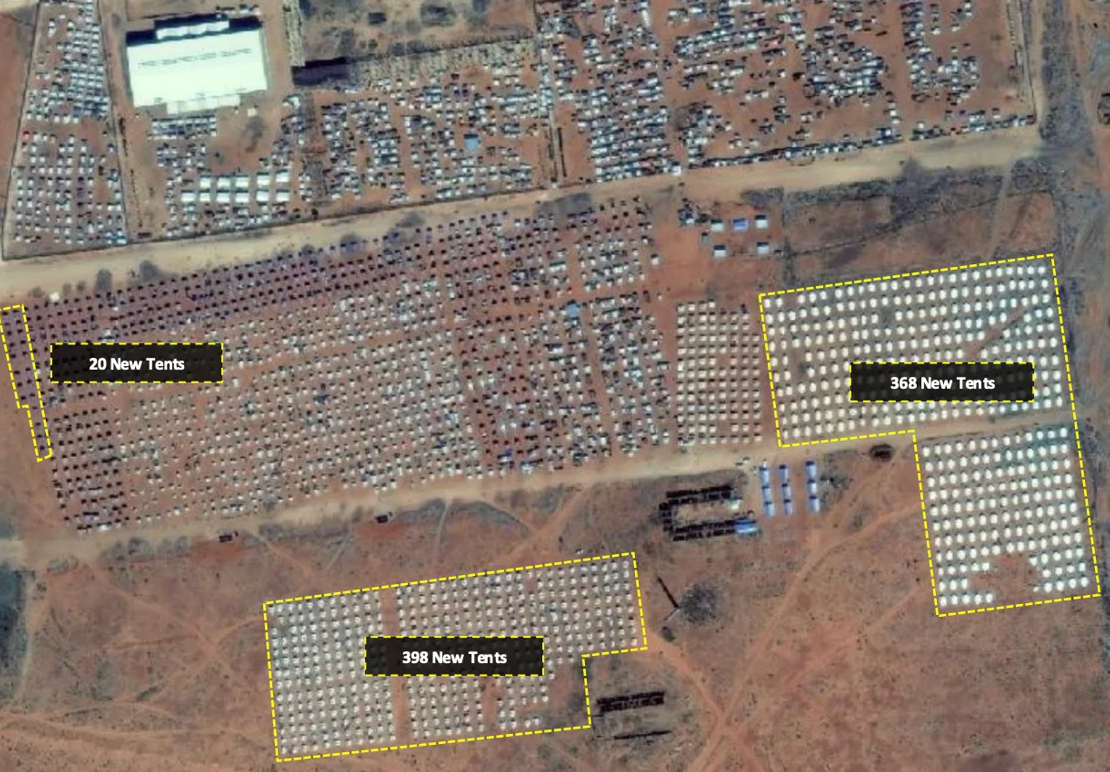
Satellite images published by the Yale Humanitarian Research Lab (HRL) show an increase of at least 786 tents at a displacement camp in El Obeid between 2 and 14 January.
Hanaan said that, even as she left Kadugli, people were arriving from villages in the area that had been taken by the RSF and SPLM-N, believing the city would be safer.
“A displaced person replaces another displaced person,” she said.
She added that people had to choose their routes out of the city “based on ethnicity or skin colour”.
“There are four exits from Kadugli, all of them non-main roads, and you must choose a road where you will not be questioned or targeted because of who you are,” she said.
“Otherwise, RSF or SPLM-N may stop you, and you could lose your life. Even displacement has become tribal. I don’t know how we survived.”
After leaving Kadugli, Hanaan and her family walked for more than 12 hours before reaching a detention camp run by the RSF and SPLM-N. She said many people are forced to stop at such camps, either out of desperation or because they are searching for relatives detained on the road.
“They [officials at the camp] asked why families stayed in Kadugli for so long and said we should have left earlier,” Hanaan said.
“We were forced to lie and say we were farmers, because if we said we lived in our homes, they would accuse us of being army supporters. Men are often accused of collaboration and targeted for forced recruitment.
“If you are Nuba [a member of one of a number of ethnic groups inhabiting South Kordofan’s Nuba Mountains] traveling through RSF areas, you face hours of interrogation.”
The group arrived in El Obeid after travelling for nine days and collectively paying out millions of Sudanese pounds (SDG) in money extorted at checkpoints. The safest route also required first going south and crossing into South Sudan, where border officials demanded 30,000 SDG ($50) per person in “immigration fees”.
‘Last year, people survived on stored food. This year, there is nothing’
In its latest assessment of the situation in Kordofan, the Famine Early Warning Systems Network (FEWS NET) said that “protracted, extreme siege conditions” had caused a famine in Kadugli and possibly in Dilling.
It added that, absent a change in the siege, it was possible the famine would persist in both cities through May.
It also said the spillover effects of the siege - including trade constraints, looting, and displacement - were expected to create emergency levels of food insecurity, including possible famine, in the surrounding rural region.
In December, the SAF government of Khartoum state banned the transport of goods across the state’s western border into Kordofan, further cutting supplies into the region.
The UN was able to make deliveries of aid to Kadugli and Dilling in August and October, but said at the time that “establishing a sustained humanitarian corridor for aid into these hard-to-reach areas is vital to save lives”.
Hanaan said humanitarian conditions in Kadugli before she left were “beyond description”.
“Since the first shot was fired in Khartoum [at the start of the war], roads were closed, there was no food supply, and no medicine except what civilians could provide themselves,” she said.
“Prices are very high and people have no sources of income. One kilo of sugar costs 50,000 SDG, while government employees earn less than 50,000 SDG per month. Can you imagine?”
On Monday, the Sudan Doctors Network (SDN) said the five government hospitals and 10 health centres in Kadugli were operating at “no more than 50% of their capacity” because of the siege, personnel shortages, and a lack of supplies.
Hanaan said the capture of farming villages around Kadugli by the RSF had also compounded the impact of a poor harvest.
“This is the main reason for famine and food shortages,” she said. “Last year, people survived on stored food. This year, there is nothing.”
Dilling has ‘escalated dangerously’
In Dilling, seven civilians were killed and 32 were injured in a drone strike on a market on Thursday, according to SDN.
The group said three children and two women were among the dead and accused the RSF of carrying out the strike.
Speaking from the city, civilian Kabashor* said the situation had “escalated dangerously” and that many families were similarly trying to evacuate.
“Last week, some days were relatively calm, but at any moment bombardments or attacks can occur,” he said.
He added that there were only two hospitals operating in Dilling, one near the market and one further away, but that the people injured in Thursday’s strike were taken to the one further away for fear that the one nearby would be targeted in further strikes.
A communications blackout also remains in place in the city, and anyone caught using a satellite device faces interrogation by the army.
Kabashor said the journey to El Obeid or South Sudan was dangerous, expensive, and could take weeks, but that people in the city “literally have nothing left”.
*Names changes due to security concerns
The weekly dispatch features the latest developments, first-hand testimony, footage, photos, stats and analysis on Sudan. We can connect you with voices from the ground, experts, and survivors of the war. Get in touch on +44 7514 796 678 or sudan@avaaz.org
To get this briefing in your inbox each week, sign up here.
Deploying a civilian protection mission offers the most direct path to protecting civilians and stemming atrocities in Sudan, according to a paper published Tuesday.

More than 21,000 people have been displaced by renewed fighting in Blue Nile state, according to reports, with both sides believed to be sending additional forces to the region and aid workers warning of a “catastrophic” impact for civilians.


Avaaz Foundation
110 Golden Lane | London, England, EC1Y 0TG
1330 6th Avenue, Suite 23A | New York, NY 10019, USA



.svg)


