
WED 22 JUL - At least 22 civilians have been killed in attacks believed to have been carried out by the Rapid Support Forces (RSF) in a strategic town in North Kordofan, according to reports.
Rahad, south east of state capital El Obeid, has over recent days seen drone strikes on the town itself as well as ground attacks and looting in nearby villages.
The town sits on a key highway linking eastern Sudan and capital Khartoum with El Obeid, a commercial and logistics hub on which the RSF has long sought to impose a siege.
On Sunday, 16 civilians were killed in an attack on Al Musalamiya, a village to the south of Rahad, local sources told the UN’s Office for the Coordination of Humanitarian Affairs (OCHA).
Dozens more were injured, according to Al Jazeera, while livestock and agricultural vehicles were reportedly looted.
Footage circulating online appeared to show RSF soldiers celebrating in front of a sign that read: "Al-Musallamiya Neighborhood Health Center".
One soldier says into the camera: “Greetings to [RSF leader] Hemedti and to the commanders on the front lines.” Heavy gunfire can also be heard in the background.
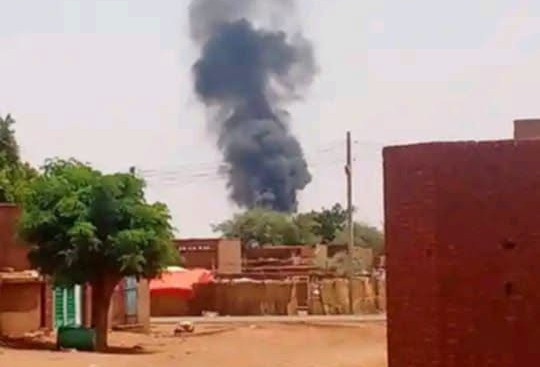
Also on Sunday, six civilians were killed and 27 others were injured in drone strikes on the main market in Rahad and a nearby residential neighborhood, Darfur24 reports.
Two of those killed and six of the injured are believed to have been children aged between six and 14, according to UNICEF.
One community leader told Darfur24 that a drone fired four missiles in total, with one hitting a commercial truck that had parked up after unloading.
Footage purportedly shot in the city showed the burned-out shell of a flatbed truck with large scorch marks in the surrounding earth, while another image showed thick black smoke rising into the sky.
Speaking to Avaaz on Tuesday, Israa*, a resident of Rahad who left five days earlier, said the situation in the city was “getting worse every day”.
“I left because there was no water, no electricity, and the markets were no longer operating due to the drone attacks and repeated targeting,” she said.
“Fear is increasing because of the constant presence of drones and because RSF troops are positioned around the town and in nearby villages. They have entered some of these villages and looted everything they could find.”
El Obeid is currently held by the Sudanese Armed Forces (SAF) but is surrounded to the North, West, and South by territory held by the Rapid Support Forces (RSF) and allied Sudan People’s Liberation Movement-North (SPLM-N), with the highway to the east providing the only access to the city.
Targeting the highway, and towns like Rahad situated along it, makes it possible for the RSF to hamper supplies to El Obeid even in the absence of a full siege.
Capturing the town could also allow the group to exploit the resources and revenue from agricultural areas and local markets in the surrounding areas.
“In recent weeks, the RSF has been targeting commercial trucks travelling along the road between El Obeid and Al-Rahad. Several traders have reportedly been killed while travelling with their goods,” Israa said.
“Many families are unable to leave. The road from Al-Rahad to El Obeid is dangerous and frequently targeted. Transportation costs are extremely high, and it is very difficult to find a vehicle.
“In many cases, people can only travel in traders’ vehicles, which are themselves at risk of RSF attacks.”
Israa added that services in the city had already been stretched by an influx of displaced people over the course of the war, exacerbating water and power shortages, and that phone and internet connectivity was frequently disrupted.
“This makes it extremely difficult to document casualties, contact humanitarian organisations, or even check on family members,” she said.
“I don't understand why they want to destroy our lives. We've already been through so much. We can't take any more.”
On Friday, following a visit to El Obeid, Abdallah Aldawart, country director for Sudan at the World Food Programme, told a press conference that the combined population of residents and displaced people in the city could be as high as 1.5 million.
“What I saw was a city that is becoming the epicentre of Sudan’s displacement and hunger crisis,” he said.
He added that, despite gaining access to the city, his teams were only able to distribute food rations of half the normal size due to funding shortfalls.
“We can deliver the food and we can be in the city. It is only resources that are limiting our operations,” he said.
Attacks on at least four communities in North Darfur that destroyed markets and left thousands displaced have been confirmed by satellite images.
The attacks, which included arson, targeted villages in the Um Baru region of the state between 12 June and 7 July, according to the latest report from the Yale Humanitarian Research Lab (HRL).
Earlier this month, reports suggested at least six villages populated predominantly by the Zaghawa - an ethnic group historically targeted by the RSF - had been razed following clashes between the RSF and the SAF-allied Joint Forces.
Yale HRL said imagery showed “damage consistent with arson attacks” in the communities of Hazan Orschi, Quarbara, Um Baru, and Abu Leha as well as damage to at least three markets.
The damage appeared to have been inflicted in ground-based attacks, it said, while unconfirmed reports suggested the villages were also targeted by drone strikes.
.png)
Yale HRL said that “no other major damage is visible in the affected communities during this period”, though added that the report relied heavily on low-resolution imagery and likely provided an “undercount” of the overall damage.
The attacks came amid clashes following an offensive launched by the Joint Forces against RSF areas from territory it controls on the border between North Darfur and Chad, particularly around the border town of Tine.
An estimated 7,250 people were displaced from villages in the Um Baru region between 17 June and 3 July, according to the International Organization for Migration.
Speculation suggested that the Joint Forces were targeting Geneina, a major stronghold for the RSF in West Darfur, although reports in recent days said the city had been reinforced with thousands of soldiers as well as military equipment and defensive berms, making an attempted ground assault less likely.
New US sanctions responding to the alleged use of chemical weapons by SAF came into force on Monday.
Under the sanctions, first announced last month, the US will oppose financial or technical assistance to Sudan from international institutions and ban the export of most goods and technology to the country.
The measures exclude food and agricultural products as well as humanitarian aid.
The State Department said the US was taking “action against those responsible for perpetuating violence, obstructing peace efforts, and fueling the war in Sudan”.
“The United States also calls for an end to all external support to the belligerents and urges all our partners to press for a comprehensive cessation of hostilities and increased, unhindered humanitarian access,” it said.
The announcement did not state when or where the US believed SAF had used chemical weapons.
In January 2025, citing US officials, the New York Times reported that the RSF had on two occasions in the preceding months used a gas believed to be chlorine to target RSF forces in a remote area of Sudan.
In November, citing analysis of open source images, France24 reported that SAF had dropped chlorine gas barrels from the air while recapturing a refinery north of capital Khartoum from the RSF.
In a statement on Sunday, the SAF foreign ministry described the sanctions as “illegal” and claimed that the motivation behind them was “purely political”.
“The Sudanese government has refuted these claims, which lack any foundation, ever since they were raised in the media attributed to anonymous sources,” it said.
The weekly dispatch features the latest developments, first-hand testimony, footage, photos, stats and analysis on Sudan. We can connect you with voices from the ground, experts, and survivors of the war. Get in touch on +44 7514 796 678 or sudan@avaaz.org.
To get this briefing in your inbox each week, sign up here.
Deploying a civilian protection mission offers the most direct path to protecting civilians and stemming atrocities in Sudan, according to a paper published Tuesday.

More than 21,000 people have been displaced by renewed fighting in Blue Nile state, according to reports, with both sides believed to be sending additional forces to the region and aid workers warning of a “catastrophic” impact for civilians.


Avaaz Foundation
110 Golden Lane | London, England, EC1Y 0TG
1330 6th Avenue, Suite 23A | New York, NY 10019, USA



.svg)


