
WED 20 MAY - The United Arab Emirates is “fully responsible for financing and arming” the Rapid Support Forces (RSF), according to a senior commander who has defected from the group.
Ali Rizq Allah, also known as Savannah, said the war was “being managed by major powers” and that he wanted to “reject any foreign intervention” in Sudan.
Announcing his initial defection last week, Savannah said he was no longer affiliated with any group, but on Saturday appeared at a press conference in Khartoum and confirmed he would fight alongside the Sudanese Armed Forces (SAF).
“We are wearing military uniforms to defend the Sudanese people and we reject any foreign intervention,” he told the event.
“The militia [RSF] has weak capabilities in operating strategic weapons such as drones and heavy artillery, so they rely on mercenaries to operate them, and the UAE is fully responsible for financing and arming the militia.”
He also claimed to have helped prepare six airports - including sites in Amdjarass on the Chad border, Central African Republic, and Ethiopia - to receive supplies for the RSF, adding that drones were now being launched from some of the same sites.
The UAE has long been accused of supporting and financing the RSF, allegations it denies, while reports by the New York Times and others suggest it has helped smuggle weapons into Sudan via neighbouring countries. In January 2024, a UN Panel of Experts report said there was “credible” evidence the UAE was supplying weapons to the RSF.
Savannah held the rank of brigadier general in the RSF and reportedly led operations in Kordofan and Darfur.
He has been accused of a number of war crimes, particularly during the capture of the West Kordofan city of En Nahud in May 2025, where he is alleged to have overseen the looting of the commodities exchange, Ayin reports.
Savannah claimed the RSF had carried out the executions of a number of commanders it considered a threat and that he expected to see more defect to SAF.
“In the coming weeks there will be more defections and I would not be surprised if even Abdelrahim Dagalo [brother of RSF leader Muhammad Dagalo 'Hemedti’] himself joins," he said.
“This reflects the collapse inside the RSF.”
His own defection came just a month after that of General Al-Nour Ahmed Adam ‘Guba’, reported to have been a central figure in the RSF siege of El Fasher.
Savannah also claimed to have only joined the RSF because he needed to support his children, adding that responsibility for the war “lies with those who started the war and supplied the weapons”.
The spate of recent defections is believed to be in part the result of a deliberate strategy by SAF military intelligence, with defectors reportedly being offered financial incentives.
There is also thought to be frustrations with the leadership of the RSF, particularly over supply issues and perceived favouritism towards members of the Dagalo family in the appointment of senior posts.
The return of former RSF commanders to Khartoum, which was only recaptured by SAF in March last year, has prompted nervousness among many of the city’s residents as well as questions about whether those who committed crimes while serving with the RSF will ever be held to account.
At least 28 people were killed and dozens more were injured in a drone strike on a market in West Kordofan on Tuesday, according to reports.
The Emergency Lawyers human rights group said the strike hit a market in the town of Ghubaysh at a time when it was “crowded with civilians”, adding that it held SAF “fully responsible”.
Citing witnesses, the AFP reports that an initial strike hit an RSF vehicle and a second hit a restaurant.
A SAF spokesperson told the agency that the army carried out strikes only against "military objectives" and denied responsibility for the attack.
West Kordofan is entirely controlled by the RSF, and Ghubaysh sits in its far west, close to the border with East Darfur.
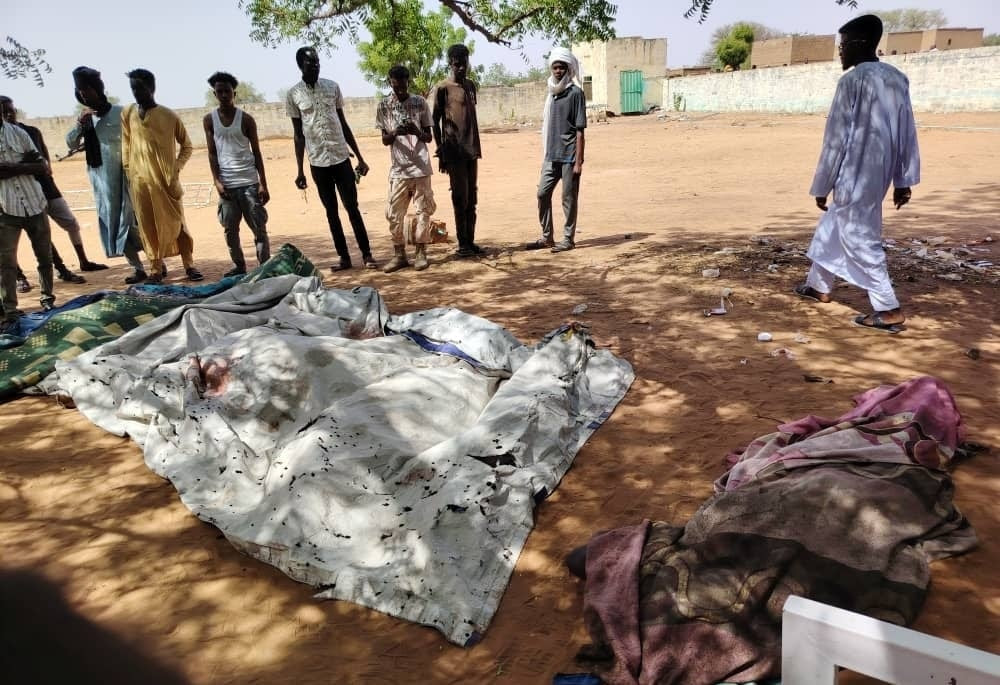
Pictures shared by the Darfur Victims Support group showed rows of body bags and people reportedly injured in the strike.
The Emergency Lawyers said Ghubaysh was a “major market upon which hundreds of thousands of civilians in West Kordofan and surrounding areas depend for food and essential goods”.
“This attack represents a continuation of a policy of using collective pressure as a tool of intimidation and starvation, creating food shortages and driving up the prices of basic commodities,” it said.
Last week, MSF said there had been at least 48 drone strikes on civilian facilities in 2026, including 28 public commercial facilities, 11 health facilities, five displacement sites, and four educational facilities.
Civilians are being deliberately targeted and their houses burned as part of efforts to move them away from gold-rich areas of the Nuba mountains, a source has told Avaaz.
It follows a report last week by the Sudan Doctors Network (SDN) that at least 61 people had been killed in clashes in villages near the city of Kauda, with nine children and five women among the dead.
Kauda, located in the centre of the state, is a Sudan People’s Liberation Movement-North (SPLM-N) stronghold and the de facto capital of the group's territory in South Kordofan.
SDN said last Wednesday that fighting over the previous weeks between the SPLM-N and the Otoro people, one of the ethnic groups inhabiting the Nuba mountains, had seen civilians “directly and indiscriminately targeted”.
Citing witness testimony, it said the SPLM-N was alleged to have carried out “extrajudicial killings, slaughtering, burning of homes and shops, as well as widespread looting of property”.
“The testimonies obtained by the network indicate that Otoro areas have become the scene of horrific violations against their inhabitants, with villages and areas around Kauda subjected to systematic burning and restrictions imposed on civilians,” it said.
The fighting has led to significant displacement from Otoro areas, leaving many without shelter or access to food or medical supplies, Darfur24 reports.
Speaking to Avaaz on Tuesday, Somia*, a civilian in a village outside Kauda, said clashes last week had occurred after the SPLM-N tried to forcibly disarm members of the Otoro community as part of attempts to move them from the mountains around Kauda.
“The tensions had been growing over gold-rich areas controlled by the Otoro community,” she said.
“The community rejected attempts to take control of these areas for mining activities linked to RSF and Abdulaziz Al-Hilu [the leader of the SPLM-N in South Kordofan] interests.
“The clashes led to houses being burned, Kauda market being closed, and Starlink internet access being cut.
“There are also many arrests targeting volunteers, journalists, and anyone not affiliated with or carrying weapons for the SPLM-N.”
In a statement on 8 May, the SPLM-N acknowledged that it had deployed forces to the area, but claimed they had been sent to “separate” fighters from the Otoro and the Shawaya, another local tribe, following a border dispute.
It said members of the Otoro had taken part in a committee set up to agree on borders in the area, but had later rejected the committee’s rulings and removed concrete posts put in place to mark the new boundaries, leading to an outbreak of fighting on 12 March.
The SPLM-N said a “small group of officers“ from the Otoro had orchestrated a “rebellion” against the SPLM-N forces sent to the area and that it was “dealing with this group according to the law”.
“We appeal to all the residents of the region, especially the Otoro tribe, to restrain and stay away from the areas where the rebel group are present and to live their lives normally,” it said.
SAF has reportedly taken a string of towns in Blue Nile, adding to recent gains that have halted advances in the state by the RSF and SPLM-N.
The army said on Monday that it had recaptured the towns of Dukan and Keren Keren, both of which fell to the SPLM-N earlier this month. It followed the recapture on Friday of Khor Hassan, which had been held by the RSF since March.
The opening months of this year saw the RSF and SPLM-N launch attacks and take territory across the south of Blue Nile, and most notably the town of Kurmuk, which sits on the border with Ethiopia.
Dukan and Keren Keren sit to the east of the main highway linking Kurmuk with state capital Damazin, while Khor Hassan lies further south, also close to the border.
Between the two areas is Al Kili, a garrison town that fell to the RSF in late April but was retaken by SAF last week.
As well as preventing further progress by the RSF and SPLM-N towards Damazin in the north, the recent gains by SAF could allow it to target Kurmuk and hamper the supply lines that the RSF has been able to open from Ethiopia.
Footage circulating online purportedly showed the commander of the brigade that led the assault on Dukan and Keren Keren celebrating with his troops.
In a statement, SAF claimed its forces had inflicted “significant losses in lives and equipment” on the RSF, adding that the aim of ongoing operations was to “cleanse all lands defiled by the rebellion and reinforce security and stability in the region”.
Fighting in the region has caused significant displacement across the south of the state, with more than 49,000 people displaced between 11 January and 4 May and a further 3,860 displaced just on 10 May, according to the International Organization for Migration.
The senior advisor to President Trump on African Affairs has described SAF as the “existing government” of Sudan, appearing to affirm US recognition of the Port Sudan authorities.
Speaking to Al Arabiya, Boulos said the US is “against any vacuum” or “division of Sudan” and would “never recognise any parallel government”.
“Even the current government, we deal with it as the existing government, but we do not recognize any parallel government,” Boulos said, according to Sudan War Monitor.
The RSF and its allies - collectively known as Tasis - have declared a parallel government for Sudan, led by Hemedti and run from South Darfur capital Nyala, but SAF comprises the traditional military of Sudan and is widely considered the de facto government.
Boulos said the US wanted to avoid a “Libyan scenario" in which Sudan fragments into competing areas of territorial control and governance.
Throughout the war, the US has sought to avoid being seen to recognise or engage more with either party, preferring instead to focus on mediation through bodies like the Quad, made up of the US, Egypt, Saudi Arabia, and the UAE.
Saudi Arabia and Egypt are both believed to be backing SAF, the former through diplomacy and financing, the latter with military support.
A visit to Oxford by Sudanese Prime Minister Kamil Idris last week ended in an altercation between protesters and members of Idris’s entourage, according to reports.
Idris, who took office in May last year and serves under SAF leader Gen Abdel Fattah al-Burhan, was in the city on Wednesday to speak at the Oxford Union.
Protesters gathered outside the Union to object to the appearance and reportedly met Idris as he exited the event.
Footage online showed a number of men wearing suits pushing and shoving a group who had gathered next to a car holding placards and Sudanese flags.
Thames Valley Police confirmed that it was investigating a report of an assault, though added that no one was injured during the incident.

In a statement, Oxford University Sudanese Society, which wasn’t involved in organising the event, said it “unequivocally condemns the violence that took place outside the Oxford Union”.
“There is no setting and no level of seniority in which putting hands on a peaceful protester is acceptable. The right to dissent is one of the bedrock conditions of life in this country, in this city, and at this institution,” it said.
“A visiting delegation does not bring its rules of engagement with it; it accepts ours. Peaceful protest is the condition under which visiting officials are received here, not a privilege to be tolerated or contained.”
Earlier this month, Idris said the event would focus on the “responsibilities of leadership in times of crisis” and the “importance of international cooperation in building peace, dignity, and recovery”.
“I look forward to engaging with students and future leaders,” he said.
Idris’s trip to the UK included visits to the Cambridge Union and the Houses of Parliament. It also followed a reception with the Pope at the Vatican.
A report by Sudanese state news agency SUNA said the trip was intended to mark the “beginning of a new phase in the course of Sudan's foreign relations” that would “expand circles of dialogue” and "mobilize support for the Sudanese peace initiative".
*Names changed due to security concerns.
The weekly dispatch features the latest developments, first-hand testimony, footage, photos, stats and analysis on Sudan. We can connect you with voices from the ground, experts, and survivors of the war. Get in touch on +44 7514 796 678 or sudan@avaaz.org.
To get this briefing in your inbox each week, sign up here.
Deploying a civilian protection mission offers the most direct path to protecting civilians and stemming atrocities in Sudan, according to a paper published Tuesday.

More than 21,000 people have been displaced by renewed fighting in Blue Nile state, according to reports, with both sides believed to be sending additional forces to the region and aid workers warning of a “catastrophic” impact for civilians.


Avaaz Foundation
110 Golden Lane | London, England, EC1Y 0TG
1330 6th Avenue, Suite 23A | New York, NY 10019, USA



.svg)


