
WED 6 MAY - The Sudanese Armed Forces have accused the United Arab Emirates and Ethiopia of a “direct act of aggression” over their alleged involvement in drone strikes across Sudan in recent months.
It follows a wave of strikes over the weekend that reportedly hit sites in White Nile, Gezira, Gedarif, North Kordofan, and Khartoum states, including Khartoum International Airport.
The UAE has long been accused of providing military and financial support to the Rapid Support Forces (RSF), while recent evidence suggests Ethiopia is allowing the group to launch attacks from its territory.
At a press conference late on Monday, a SAF spokesman claimed to have “a set of documented evidence” indicating the involvement of “both the United Arab Emirates and Ethiopia in hostile actions targeting Sudan” going back to March.
He alleged that multiple drones had been launched from Bahir Dar Airport, a site in Ethiopia around 220km from the Sudanese border, and that data from one drone intercepted on 17 March suggested it was “owned” by the UAE.
The spokesman added that another drone intercepted on Friday after targeting sites around Khartoum had also been launched from Bahir Dar.
“This will not be met with silence,” he said.
“Our armed forces remain fully prepared to respond to any threat in a manner that preserves the nation’s dignity, sovereignty, and security."
Sudan also recalled its ambassador to Ethiopia for "consultations”.
In response, the Ethiopian foreign ministry described the allegations as “baseless” and accused SAF of aiding the Tigray People's Liberation Front, a former ruling party of Ethiopia that fought a war with the federal government between 2020 and 2022.
It went on to “affirm [Ethiopia’s] bonds of friendship” with the people of Sudan and call for “dialogue between the belligerents in the Sudanese civil war”.
Last month, a report from the Yale Humanitarian Research Lab (HRL) concluded with “high confidence” that the RSF had been receiving support at a base run by the Ethiopian National Defense Force in the Ethiopian town of Asosa.
Satellite images suggested that pickup trucks of the sort typically used by the RSF were being delivered to the base and fitted with heavy machine guns before being used in attacks across the border in Sudan.
The UAE has not yet responded to the allegations, but has previously denied backing the RSF.
Drone strikes target sites in SAF areas across Sudan
Recent days have seen a wave of drone strikes targeting SAF-held territory across Sudan.
On Monday, strikes hit a number of locations around Khartoum state, including the international airport, which only reopened in February and last week received its first direct international commercial flight since the start of the war.
Also hit were a signal corps site in Khartoum Bahri and the Al-Markhiyat military camp in northern Omdurman, Sudan Tribune reports.
Social media footage thought to have been shot near the airport showed thick clouds of black smoke rising into the sky.
The Emergency Lawyers human rights group said the strike disrupted air traffic, destroyed “vital facilities”, and damaged homes in the nearby Burri neighbourhood, while the UN said keeping the airport operational was vital for humanitarian access.
Footage reportedly shot in a residential area showed an active fire in the remains of a building, while the governor of Khartoum said two civilians had suffered minor injuries.
The incident followed a strike on Saturday in an area south of Omdurman in which Emergency Lawyers reported that five civilians were killed.
Footage showed fire coming from under the bonnet of a burned-out car chassis in the middle of a remote area.
Recent months have seen a lull in drone strikes on the capital and the surrounding region.
Brother of Sudan Shield leader among six killed in strike
Also on Saturday, a drone strike hit the family home of Sudan Shield commander Abu Agla Keikel, who defected from the RSF to ally with SAF in October 2024.
The strike - in the village of Al-Kahli Zaidan in Gezira state - killed six people, including Major Azzam Keikel, a brother of Keikel’s and a commander in Sudan Shield, according to Sudan Tribune.
Sudan War Monitor reports that Keikel himself was near the home at the time but survived the attack unharmed.
SAF commander General Abdel Fattah al-Burhan visited Al-Kahli Zaidan on Sunday to offer his condolences to the family, according to SAF.
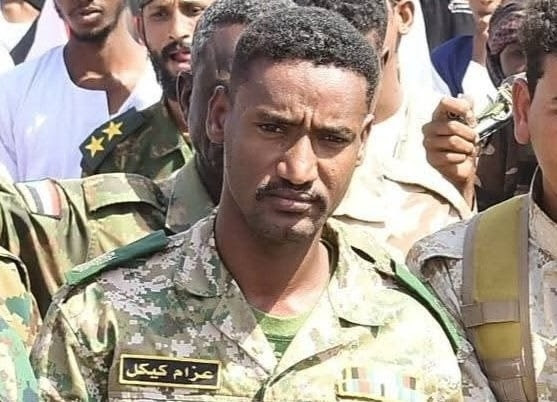
The apparent attempt to assassinate Keikel follows the defection of another senior RSF commander, General Al-Nour Ahmed Adam “Guba”, to SAF last month.
Other notable infrastructure targeted in recent days included a television station in North Kordofan capital El Obeid, where pictures from Friday showed damage, debris, and partially-collapsed ceilings in multiple rooms of a building.
Also struck was a fuel depot near sites of both the Kenana Ethanol Production Facility and the Kenana Sugar Factory in the White Nile industrial town of Kenana, according to the latest Yale HRL report.
‘Almost daily’ shelling brings Dilling healthcare to ‘near-total collapse’
The systemic targeting of medical facilities in the South Kordofan city of Dilling has led to severe shortages of supplies and the “near-total collapse” of the healthcare system, according to the Sudan Doctors Network (SDN).
The group said bombardment by both the RSF and the allied Sudan People’s Liberation Movement-North (SPLM-N) had put numerous sites out of service and placed thousands of civilians, especially women and children, at “grave risk due to the absence of life-saving services”.
A long-running siege on Dilling, which is held by SAF, has been intermittently lifted over recent months, but the city remains partly surrounded by RSF territory and cut off from El Obeid to the north.
Speaking to Avaaz from Dilling, medical volunteer Ali* said drone strikes and staff shortages had put the city's teaching hospital, as well as 9 of its 13 health centres, completely out of service.
“Many medical staff have left for safer areas because of insecurity, and a lot of services have stopped due to transport and logistics problems,” he said.
“There is also a serious shortage of medicines, especially for chronic illnesses like diabetes and high blood pressure, as well as emergency drugs.
“The operating theatre is not working, and there are many cases needing surgery.”
Aid worker Khalid*, also speaking from Dilling, said only one hospital was still operating and taking cases, but that even it lacked medicines and basic medical staff.
He added that shelling continued on an “almost daily basis” and could occur “anywhere inside the city at any time”, affecting civilian areas and making movement around the city fraught with risk.
“The most affected areas are the western and northern neighbourhoods, and there are injuries and deaths among civilians, especially children, women, and the elderly,” he said.
“The damage to homes includes complete burning of some houses, partial fires in others, and damage caused by shelling.
“Schools have also been damaged due to drone attacks, and the market was affected by indiscriminate shelling and heavy weapons.
“In terms of water, all residents rely on hand pumps, but these are not sufficient and many are broken and need maintenance.
“The main urgent needs for civilians are food, medicine, water, and shelter.”
The weekly dispatch features the latest developments, first-hand testimony, footage, photos, stats and analysis on Sudan. We can connect you with voices from the ground, experts, and survivors of the war. Get in touch on +44 7514 796 678 or sudan@avaaz.org.
To get this briefing in your inbox each week, sign up here.
Deploying a civilian protection mission offers the most direct path to protecting civilians and stemming atrocities in Sudan, according to a paper published Tuesday.

More than 21,000 people have been displaced by renewed fighting in Blue Nile state, according to reports, with both sides believed to be sending additional forces to the region and aid workers warning of a “catastrophic” impact for civilians.


Avaaz Foundation
110 Golden Lane | London, England, EC1Y 0TG
1330 6th Avenue, Suite 23A | New York, NY 10019, USA



.svg)


