
TUE 16 JUN - More than 1,000 civilians have been killed by drone strikes in Sudan this year, the UN has said, amid a renewed spate of attacks on the key city of El Obeid.
Speaking in Geneva on Monday, UN High Commissioner for Human Rights Volker Türk said the deaths, documented between January and May, showed that the “horrific conflict has expanded and escalated”.
He added that the increased use of drones in Sudan was part of a “global shift in how war is waged” and that “autonomous weapons cannot become a license for atrocity crimes”.
The warning comes after at least 23 people were killed and dozens injured in a wave of drone strikes reportedly carried out by the Rapid Support Forces (RSF) on the key city of El Obeid.
On Wednesday, four people were killed and 12 were injured in a strike on a funeral procession at a cemetery, while an earlier strike the same day killed five and injured 12, according to the Emergency Lawyers human rights group.
It said at least 13 people were killed in subsequent strikes on the eastern Al-Muwazafin neighbourhood, the southerly airport district, and on areas around the 5th Infantry Division headquarters in the centre of the city.
A further attack early on Thursday killed the driver of a truck carrying food supplies into the city from the south, the group added.
Citing local sources, Sudan Tribune and the Associated Press reported similar tolls for the various strikes, as did the Sudan Doctors Network.
On Sunday, the International Federation of Red Cross and Red Crescent Societies said one of its volunteers, Ahmed Yaqoub Othman, was among those killed on Wednesday and that he had been providing care to people injured in earlier strikes at the time.
Pictures shared by activists on social media showed five body bags purportedly containing those killed in the strikes, while others showed collapsed ceilings and rooms littered with charred debris.
Further strikes were reported on Friday, Saturday, Sunday, and Tuesday.
El Obeid, which is capital of North Kordofan state and an important regional hub, is held by the Sudanese Armed Forces (SAF) but has long been targeted by the RSF and allied Sudan People’s Liberation Movement-North (SPLM-N).
Speaking to Avaaz, Hamed*, a civilian in the city, said drones were frequently visible overhead and that explosions from strikes were being heard on an almost daily basis.
“Last week one of the strikes hit our residential neighbourhood, which is crowded with civilians and displaced people, resulting in many deaths. What shocked people even more was that, after people went to dig graves and bury the victims, the area was reportedly struck again.
“Many people believe the RSF knows exactly what it is targeting and that civilians are the primary victims.”

Strikes over the weekend also destroyed around eight fuel stations in El Obeid and, as part of an apparent attempt to hinder fuel supplies to the city, targeted fuel trucks in the surrounding area, Sudan Tribune reports.
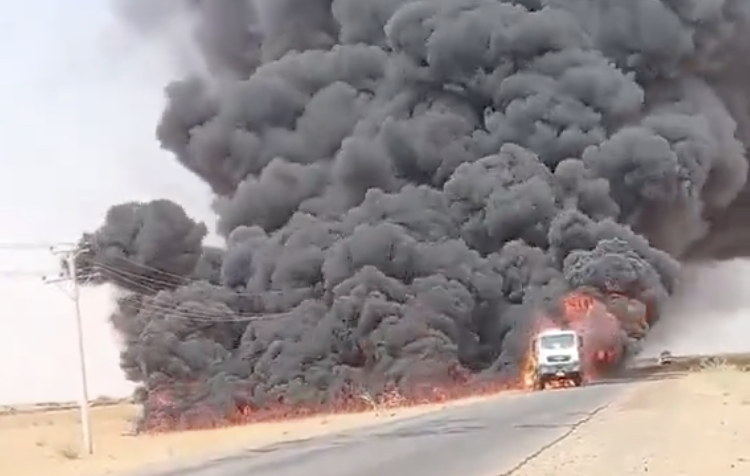
Footage circulating on Monday reportedly shot on the highway leading towards El Obeid from neighbouring White Nile state showed a wide column of thick black smoke billowing from a tanker.
Hamed said strikes targeting fuel supplies were threatening the operation of the city’s water pumping stations, transportation, and hospitals.
“Fuel prices continue to rise following repeated attacks on fuel infrastructure, which has also driven up food prices,” he said.
“This comes on top of broader inflation linked to the collapse of the national currency. Transportation has become increasingly difficult, forcing many people to walk long distances."
El Obeid’s position on the highway, which connects east and west Sudan, is one of the factors that makes it a key node for commerce and logistics in the country.
The RSF - which, along with the SPLM-N, controls much of the surrounding territory - has long sought to reimpose a siege lifted in February 2025, but SAF has largely been able to maintain the flow of supplies from territory it controls to the east.
On Monday, Sudan Tribune reported that the RSF was deploying “unprecedented” reinforcements around El Obeid and could launch a ground assault within 72 hours.
Citing military sources, it said additional fighters had come from Darfur and West Kordofan states and were amassing at points to the west, north, and south of around the city in apparent preparation for a multi-axis offensive.
Any assault would be part of efforts to make territorial gains ahead of the rainy season, which will set in over the coming weeks and typically puts a stop to ground fighting.
“For three years, the city has endured siege conditions, hunger, and severe restrictions, while residents have shown remarkable resilience in protecting their community,” said Hamed.
“Today, many believe Sudan [the SAF government] faces a moral responsibility to support El Obeid and prevent it from experiencing the same fate as El Fasher.”
The Ethiopian military continues to provide support to the RSF from a base on Ethiopian territory, according to the Yale Humanitarian Research Lab (HRL).
It follows satellite images published in early April that showed car transporters, vehicles, and mountable heavy machine guns being delivered over a period of months to an Ethiopia National Defense Force (ENDF) facility in the town of Asosa.
The vehicles and weaponry appeared to match those seen in open source footage being used by the RSF in attacks in the Sudanese state of Blue Nile, which shares a border with Ethiopia, during the same period.
The latest report from Yale HRL said that, between 29 March and 21 May, satellite images continued to show activity “consistent with the shipment and modification of light vehicles used by RSF, including the mounting of these vehicles with objects consistent with 50-caliber machine guns”.
.png)
It added that, in the weeks following the publication of the first report, much of the activity had moved within the base to an area surrounding a warehouse, a change that “may be consistent with an attempt to mitigate observation of activity at the base via satellite imagery”.
The report also presented evidence that the vehicles - commercial pickup trucks that are not armed when they arrive - were being painted to match the darker, matte colour of the vehicles typically used by the RSF.
Supplying weapons to the RSF, which has been accused of committing genocide in Sudan, would be a violation of the Darfur arms embargo.
The destruction of two key bridges in strikes carried out by each of the warring parties has led to renewed warnings about a lack of humanitarian access to parts of Sudan already at risk of famine.
The Ardamata Bridge, which sat east of the city of Geneina in West Darfur, was destroyed in a strike reportedly carried out by SAF on 9 June.
The road running through Geneina is one of the key routes for aid coming into Darfur from neighbouring Chad.
The strike came two days after another believed to have been carried out by the RSF on the Keika Bridge, which sat on the road linking the cities of Dilling and Kadugli in South Kordofan.
Pictures circulating on social media showed much of the bridge reduced to rubble, leaving a deep, impassable gap in the road.
.jpg)
Long-running sieges on Dilling and Kadugli have been sporadically broken over recent months, and last week UNICEF was able to deliver aid to both cities, but shortages of food and medicine persist.
The upcoming start of the rainy season, which makes many roads in Sudan harder to navigate, was already prompting concerns about humanitarian access.
In its latest assessment, the Integrated Food Security Phase Classification identified Dilling, Kadugli, and multiple areas of Darfur as being at risk of famine in the coming months.
On Friday, the US Bureau of African Affairs condemned the destruction of the Ardamata Bridge, saying its humanitarian partners depended on the bridge “to bring emergency food and medical supplies to… West and Central Darfur”, while the UN earlier said the Keika Bridge was “vital for civilian movement and aid delivery”.
The Emergency Lawyers said in a statement that the strikes were “completely unjustifiable” and part of a “recurring pattern of targeting civilian infrastructure and disrupting vital routes” by both sides of the conflict.
Seven civilians, including a child, have reportedly been killed in continued drone strikes on the North Darfur town of Kernoi.
A source in the town told Avaaz that a strike hit a restaurant in the market on Friday, sparking a fire in a number of shops, and that it was the fourth such attack on the town since the start of the month.
The El Fasher Resistance Committee said in a statement that seven people had been killed and 10 had been injured.
Among those killed were a 37-year-old, a 22-year-old, and a 12-year old, according to the source.
.jpg)
Pictures from the scene showed large patches of scorched earth and ash littered with smouldering debris.
It follows a series of strikes in late May in towns in North Darfur, including Kernoi, in which at least 30 people were killed.
The strikes were thought to be part of a broader offensive by the RSF to push SAF out of its last remaining areas of control in Darfur.
On Sunday, at least eight civilians were reportedly killed in ground attacks in the nearby region of Um Baru, according to the UN’s Office for the Coordination of Humanitarian Affairs.
The weekly dispatch features the latest developments, first-hand testimony, footage, photos, stats and analysis on Sudan. We can connect you with voices from the ground, experts, and survivors of the war. Get in touch on +44 7514 796 678 or sudan@avaaz.org.
To get this briefing in your inbox each week, sign up here.
Deploying a civilian protection mission offers the most direct path to protecting civilians and stemming atrocities in Sudan, according to a paper published Tuesday.

More than 21,000 people have been displaced by renewed fighting in Blue Nile state, according to reports, with both sides believed to be sending additional forces to the region and aid workers warning of a “catastrophic” impact for civilians.


Avaaz Foundation
110 Golden Lane | London, England, EC1Y 0TG
1330 6th Avenue, Suite 23A | New York, NY 10019, USA



.svg)


