
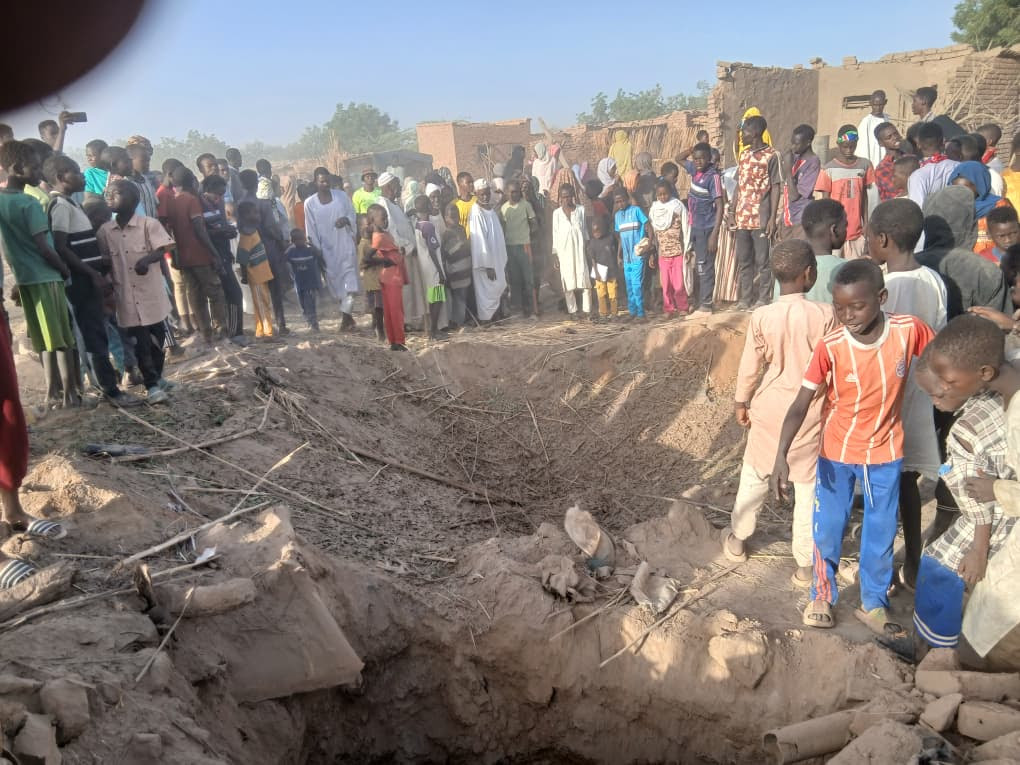
TUE 28 APR - Six civilians have been killed in an airstrike on a displacement camp in Central Darfur, according to human rights monitors.
The strike, believed to have been carried out by the Sudanese Armed Forces (SAF), hit the Al-Hamidiya camp in state capital Zalingei early on Monday.
Footage and pictures from the scene showed people gathered round a large crater in the ground littered with dust and debris.
In a statement, the Emergency Lawyers human rights group said the strike had destroyed a number of residential homes and that, of six people killed, all were civilians.
It added that the camp hosted thousands of displaced people, mostly women and children, and was a “civilian facility providing essential humanitarian services amid the acute food and health crisis" in Darfur.
Local aid coordinator Adam Rojal said 15 people had been injured in the strike, some of them critically.
Central Darfur is currently entirely under the control of the Rapid Support Forces (RSF).
The attack follows a series of strikes and ground assaults in six states across Sudan claimed by SAF in a statement released on Thursday.
In North and Central Darfur, SAF said it had targeted “gathering points of the terrorist militia” and caused “a number of casualties in their ranks”.
Two days earlier, more than 10 civilians were killed in a drone strike in Um Dukhun, a town in Central Darfur on the Chadian border, according to the UN.
The series of attacks also targeted South Darfur, North Kordofan, West Kordofan, and Blue Nile, SAF said.
The UN’s refugee agency has condemned a drone strike that destroyed an aid truck as it tried to deliver supplies to a displacement camp in North Darfur.
The truck was reportedly hit on Friday while in the town of Umm Drisaya en route to the Tawila camp, currently home to more than 700,000 displaced people.
The driver escaped without injury but the truck’s entire cargo of emergency shelter kits was destroyed.
The UNHCR said in a statement that the strike would leave 1,314 families “living in desperate conditions in Tawila without shelter”.
“Attacks against aid convoys and facilities during armed conflict are always unacceptable,” it said.
“At a time when humanitarian partners are struggling to meet the immense needs of the civilian population in Sudan, the recurrent attacks on aid convoys and facilities in the past few months are particularly abhorrent.”
Tawila’s population has swelled since the RSF took the Zamzam camp, around 45km to the east, and the nearby city of El Fasher last year, placing significant strain on aid operations in the camp.
A SAF military garrison in Blue Nile has reportedly fallen to the RSF, extending the group’s push towards the north of the state.
Troops are said to have overrun the garrison, located in the town of Al Kili, following clashes over the weekend.
It comes just a month after the RSF took the key town of Kurmuk, around 30km to the south on the Ethiopian border, in an assault thought to have been launched with support from the Ethiopian military.
Al Kili lies close to the main road connecting Kurmuk with state capital Damazin.
Footage shared on RSF social media channels and geolocated by Sudan War Monitor showed RSF fighters inside the garrison, apparently after the cessation of fighting.
In a statement, the RSF said its fighters, along with others from the Founding Alliance, had achieved the “full liberation and control” of Al-Kili and claimed to have inflicted “heavy blows to the enemy in both personnel and equipment”.
“These advanced military operations represent a significant turning point in the theatre of operations and a decisive strategic step toward ending the influence of extremist groups and dismantling their destructive agenda,” it said.
It follows a major report from the Yale Humanitarian Research Lab setting out evidence that, over recent months, the RSF has been receiving logistical support at an Ethiopian military base before launching its attacks into Blue Nile.
The group’s latest attack will fuel concern that the fighting, which has already displaced tens of thousands of civilians across the south of Blue Nile, will continue to spread through the state.
Last week, SAF claimed to have recaptured Maqaja, a small town further to the north where another SAF garrison was captured by the RSF in March.
Troops from the SAF-allied Sudan Shield militia have recently deployed to Blue Nile to support SAF in efforts to push the RSF out of the state before the start of the rainy season, Ayin reports.
The leader of Sudan Shield, Abu Aqla Kaikal, is subject to sanctions by the UK and EU for his alleged involvement in attacks against the Kanabi, a community of mostly non-Arab farmers in Gezira state.
Meningitis cases are “surging” in eastern Chad amid an influx of people displaced from Sudan, according to Médecins Sans Frontières (MSF), with one in nine infected children being killed by the disease.
Almost one million Sudanese refugees are currently living across the four Chadian provinces that border Sudan.
In the border town of Adré, the largest centre of refugees from Sudan, meningitis cases at MSF facilities rose from 18 in January to 101 just in the first two weeks of April.
Of 212 children admitted in March and April, 25 died, a fatality rate described by MSF as “shocking”.
A simultaneous outbreak of measles is also ongoing and growing at a similar rate.
“The vast majority of children affected by meningitis present severe forms,” said Léa Ledru, MSF coordinator in Adré.
Isabelle Kavira, medical activity manager in Adré, said bed occupancy for meningitis was “close to 100%, saturating our capacity and compromising care for other conditions”.
The charity said that overcrowding, poor access to healthcare and water, and malnutrition made people living in displacement camps, and particularly children, especially vulnerable to outbreaks.
It added that it had increased bed capacity in Adré and begun a vaccination drive that had reached hundreds of thousands of people, but that the challenge of keeping vaccines cold and a lack of routine immunisation meant entire populations remained exposed.
The weekly dispatch features the latest developments, first-hand testimony, footage, photos, stats and analysis on Sudan. We can connect you with voices from the ground, experts, and survivors of the war. Get in touch on +44 7514 796 678 or sudan@avaaz.org.
To get this briefing in your inbox each week, sign up here.
Deploying a civilian protection mission offers the most direct path to protecting civilians and stemming atrocities in Sudan, according to a paper published Tuesday.

More than 21,000 people have been displaced by renewed fighting in Blue Nile state, according to reports, with both sides believed to be sending additional forces to the region and aid workers warning of a “catastrophic” impact for civilians.


Avaaz Foundation
110 Golden Lane | London, England, EC1Y 0TG
1330 6th Avenue, Suite 23A | New York, NY 10019, USA



.svg)


