
TUS 23 JUN — The British Government put cosy relations with the UAE ahead of stopping the horrors unfolding in El Fasher, according to a statement released today by an expert at the centre of the affair.
Nathaniel Raymond, executive director of the Humanitarian Research Lab at Yale School of Public Health (HRL), said ministers ignored warnings of mass killings, starvation and forced displacement, choosing diplomacy and trade over action. The result, they argue, was a catastrophic failure to prevent the slaughter of thousands of civilians in the North Darfur capital.
Ahead of an International Development Committee hearing scheduled to start at 2pm BST today in the Commons, at which Raymond will testify, he submitted a statement alleging that British officials were extensively briefed on the growing danger facing civilians in El Fasher, more than two years before the city fell to the Rapid Support Forces (RSF), in October 2025.
Raymond said his team warned British diplomats and officials more than two dozen times, between July 2023 and September 2025, that an RSF assault on El Fasher was likely and that the consequences could be catastrophic.
“The warnings HRL first gave to the U.S. and U.N. Security Council in July 2023, including the U.K., internally and publicly, have now come to pass,” he wrote.
The testimony centres on the months-long siege of El Fasher, a city that had become a refuge for civilians displaced by fighting elsewhere in Sudan’s civil war. According to Raymond, his lab concluded by late 2023 that RSF forces were preparing to encircle and eventually capture the city, where hundreds of thousands of civilians, including members of the Fur and Zaghawa ethnic groups, had sought protection.
Researchers tracked village burnings, troop movements and military activity using satellite imagery and open-source intelligence. In April 2024, the lab publicly declared that the siege of El Fasher had begun after documenting a series of arson attacks on rural communities surrounding the city.
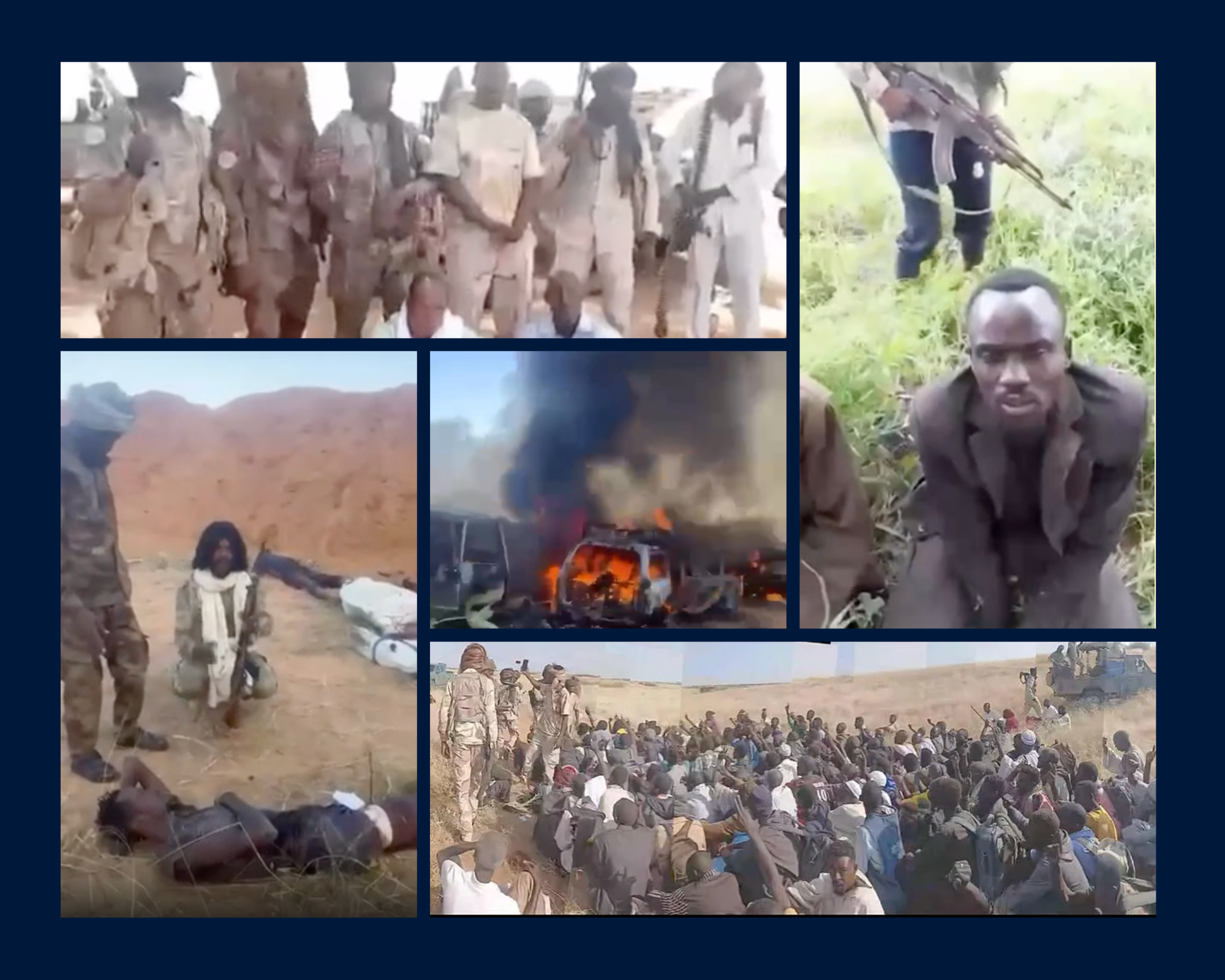
The siege lasted more than 18 months. During that period, the lab issued nearly 70 reports documenting attacks, food shortages, bombardment and the gradual isolation of El Fasher and nearby displacement camps. When the city ultimately fell to the RSF in October 2025, widespread killings, sexual violence, torture and forced displacement followed almost immediately.
The United Nations reported that at least 6,000 people were killed during the first six days after the city’s capture and concluded earlier this year that the violence bore the “hallmarks of genocide.”
Based on satellite imagery, witness accounts and other sources, the Humanitarian Research Lab estimated that as many as 60,000 people may have been killed between October and November 2025.
The statement sharply criticizes Britain’s Foreign, Commonwealth and Development Office (FCDO), accusing it of relying primarily on diplomatic efforts while declining to pursue stronger measures against the RSF and the UAE.
Raymond alleges that British officials privately acknowledged pressure from the United Arab Emirates, which has continued to deny supporting the RSF, despite a wealth of evidence to the contrary. According to the testimony, FCDO officials encouraged the lab in May 2024 to publicly release evidence linking UAE-based entities to RSF operations, implying Emirati pressure prevented them from releasing it themselves.
The testimony also alleges that British officials repeatedly downplayed the need for additional warnings as the crisis escalated. During a May 2024 meeting, Raymond said FCDO personnel suggested that civil society groups could only warn once about the city’s impending fall before risking being viewed as “crying wolf.”
Raymond argued that such a view fundamentally misunderstood the nature of atrocity prevention, particularly during a prolonged siege.
He also slammed successive British governments for failing to take meaningful action against those who breached a U.N. Security Council resolution urging a ceasefire around El Fasher.
Having paused fighting after the resolution’s passage, fighting resumed once the RSF and the UAE concluded that no significant political consequences would follow.
Raymond argued that the tragedy represented not a failure of information but a failure of political will.
He said the intelligence gathered by the lab was “more than sufficient” to support stronger policy responses, including sanctions and other measures designed to disrupt military support flowing to the RSF.
Raymond recommended that Parliament establish an independent atrocity early warning board, create a cross-government atrocity prevention operations center and conduct a review of intelligence resources available to policymakers responding to mass atrocity threats.
“The tragedy of El Fasher shows that advanced technology and analysis can provide leaders essential decision support information,” Raymond wrote. “But satellite data and computing power cannot by itself generate either political will or moral courage.”
Drone strikes in El Obeid enter second consecutive week, as international alarm grows of a repeat of El Fasher atrocities
Over the past two weeks, drone attacks by the Rapid Support Forces (RSF) in El Obeid have intensified significantly, systematically targeting civilians and critical infrastructure.
These developments come amid growing international alarm of a repeat of El Fasher. The U.S. The State Department, UN OCHA, the Africa Union and IGAD and several Western governments have urgently warned of the escalating military tension in El Obeid and the high risk of summary executions, abductions, and mass atrocities.
Recent strikes have targeted fuel stations, crowded markets, and residential neighborhoods, including a deadly strike on a fuel depot that killed nine people.
Targeted attacks on the city's eastern power transformer station on June 18 and 19 caused widespread blackouts.
According to Sudan War Monitor, geolocated videos reveal the devastating toll of recent RSF drone strikes designed to weaken El Obeid's infrastructure. One video captures a burning fuel depot following an attack just outside the city that killed nine people while a second video shows widespread destruction at a crowded market.
Citing local sources Sudan War updates, and the Sudan Tribune report similar tolls of yesterday's attack, when a RSF drone struck the Unified Shelter Camp in El Obeid, as did the Sudan Doctor Network.
Speaking to Avaaz, Ehsan, a humanitarian worker in El Obeid said fear has intensified sharply in recent days as drone attacks escalate and that explosions from strikes were being heard on an almost daily basis.
“We hear reports of RSF forces around El Obeid, but we have not seen them directly on the ground. For us, the biggest danger right now is drones, they are the main threat to people’s lives.
“They previously targeted homes, but now they are striking schools, electricity stations, fuel depots, and water facilities.”
She said attacks on critical infrastructure appear aimed at making life in El Obeid unsustainable.
“They want El Obeid to have no water, no electricity, and no healthcare. Hospitals have been attacked, power is down, fuel is running out, and most medical facilities are no longer functioning.”
While some families have started leaving the city, displacement remains limited because movement itself has become dangerous.
“Some families have left, but large-scale displacement has not happened because people are afraid to move. The situation is extremely difficult and deeply worrying.”
The weekly dispatch features the latest developments, first-hand testimony, footage, photos, stats and analysis on Sudan. We can connect you with voices from the ground, experts, and survivors of the war. Get in touch on +16466281210 or sudan@avaaz.org.
To get this briefing in your inbox each week, sign up here.
Deploying a civilian protection mission offers the most direct path to protecting civilians and stemming atrocities in Sudan, according to a paper published Tuesday.

More than 21,000 people have been displaced by renewed fighting in Blue Nile state, according to reports, with both sides believed to be sending additional forces to the region and aid workers warning of a “catastrophic” impact for civilians.


Avaaz Foundation
110 Golden Lane | London, England, EC1Y 0TG
1330 6th Avenue, Suite 23A | New York, NY 10019, USA



.svg)


