WED 11 NOV - Food, water, and fuel shortages are pushing Blue Nile into a “humanitarian crisis”, aid workers have told Avaaz, amid an escalation in fighting that has displaced more than 20,000 people.
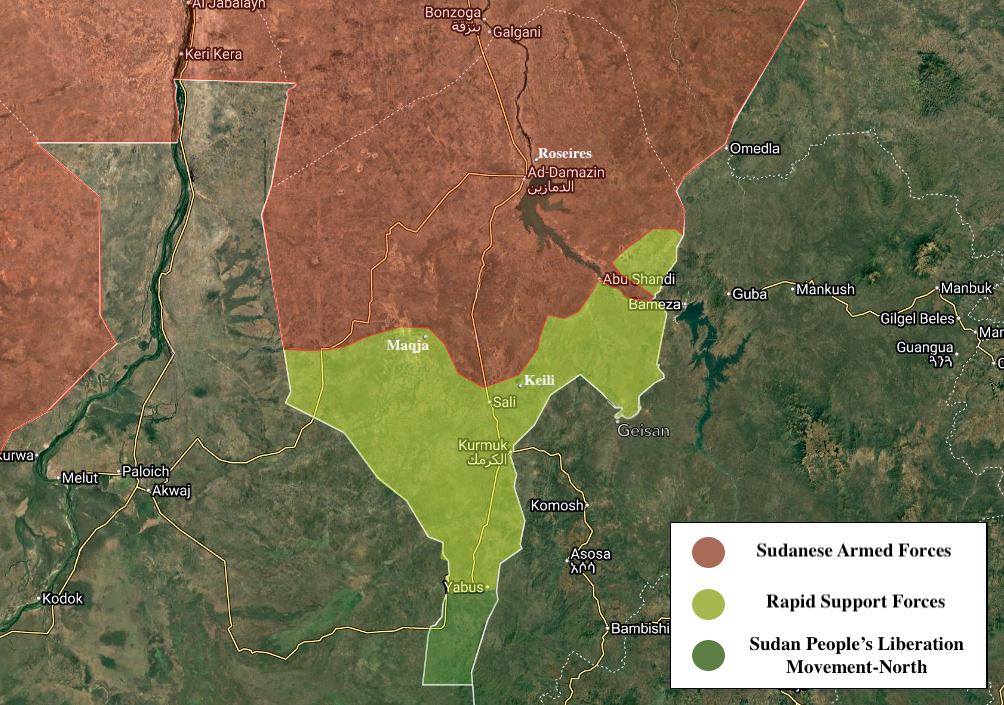
Recent months have seen renewed clashes following a series of offensives by the Rapid Support Forces (RSF), along with the allied Sudan People’s Liberation Movement-North (SPLM-N), that saw them take control of much of the south of the state.
The fighting has caused many to flee north towards state capital Damazin, currently held by the Sudanese Armed Forces (SAF), though fears remain the violence could spread to the city itself.
Speaking from Damazin, local aid worker Anas* told Avaaz the clashes had “created widespread fear” and that many were considering leaving Blue Nile altogether to escape any further escalation.
Throughout this year, the RSF has targeted areas along Sudan’s southeastern border as part of apparent attempts to open its supply lines from Ethiopia. The group is widely reported to be receiving support from external backers, most notably the United Arab Emirates, which denies the claims.
The RSF has since August pushed northwards from the key border towns of Kurmuk and Geisan, with much of the recent fighting centred on the road connecting Kurmuk with Damazin.
Last week, it took a military base in the town of Sali, which sits on the road, a gain corroborated in the latest report from the Yale Humanitarian Research Lab (HRL).
Reports on Sunday suggested the group had also taken the towns of Maqja and Keili, which sit to the road’s west and east, although both towns have already changed hands at least once in recent months.
The RSF’s closest area of control currently lies around 60km south of Damazin.
On Sunday, SAF announced that the commander of its 4th infantry division, which is based in Damazin, would be replaced by Maj. Gen. Abdel Moniem Abdel Basit, who has previously overseen operations in Sennar and Gezira states as well as Khartoum, Sudan Tribune reports.
Between 11 January and 15 October, almost 120,000 people were displaced from locations across Blue Nile state, according to the International Organization for Migration, with more than 20,000 of those displaced since 23 August.
Satellite imagery in the Yale HRL report showed an increase of more than 800 temporary structures at a displacement camp in Damazin in the month to 4 November.
‘People are expecting the situation to become even worse’
Anas said the number of displaced people was still increasing and that Blue Nile was facing a “severe humanitarian crisis”.
“Displaced families are struggling to access clean water, shelter, and food,” he said.
“Although some humanitarian organisations are providing assistance, the gap between people's needs and the available support remains huge. The situation is getting worse as more people continue to flee their homes.
“These areas affected by the fighting are mainly agricultural communities, where people depend on farming for their food and livelihoods.
“Most families were forced to flee during the harvest season, leaving behind their crops and the food supplies they would normally rely on.”
Another aid worker, Hadeel*, added that many in Damazin could no longer afford healthcare, while others were struggling to eat.
“Hunger has become so severe that some people have started breaking into homes to steal food,” she said.
“The war has had a serious impact on communities, leading to an increase in theft, particularly of food supplies, as people struggle to survive.”
Anas said SAF control of the fuel supply was also exacerbating a widespread shortage, pushing up prices, and making it harder for civilians to reach safe areas, while internet restrictions were making it harder for aid volunteers to coordinate their work or share information about the situation in each area.
“The ongoing fighting has left people terrified and many are considering leaving the state entirely and moving to safer areas such as Sennar, Khartoum, and Gezira,” he said.
“People are expecting the situation to become even worse if the fighting and displacement continue.”
At least 13 arrested in crackdown by security services
As across much of the country, the increasing use of drones is having a devastating impact on the civilian population of Blue Nile.
The governor of the Kurmuk region said on Tuesday that nine civilians had been killed and several wounded in a drone strike on the village of Bani Shku, which lies north of Keili.
Last week, a mother of three was reportedly killed and several other civilians were injured after the RSF launched an overnight drone assault targeting residential neighbourhoods in Damazin.
Footage published by Radio Tamazuj showed loud explosions and large fireballs purportedly rising into the night sky over the city.
It followed a strike last month on a displacement camp in the town of Abu Shendi, which sits southeast of Damazin on the border between the current areas of control, in which 41 people were killed, according to the Emergency Lawyers human rights group.
SAF has over recent months repeatedly claimed to have shot down drones that had crossed into Blue Nile from the direction of Ethiopia.
Recent drone attacks have led to power cuts in Damazin and Roseires, Radio Tamazuj reports, causing blackouts in residential neighbourhoods and disrupting water supplies.
Residents of the Bau and Tadamon regions, which sit to the west of Damazin, were already reportedly facing water shortages caused by inadequate rainfall and a lack of infrastructure maintenance, forcing some to walk more than 5km in search of drinking water.
The fighting is also being used as a pretext for a crackdown by the Joint Security Cell in Blue Nile, which comprises elements of the military, police, and SAF intelligence services.
Between 12 and 22 October, at least 13 civilians were arrested in Roseires on allegations of collaborating with the SPLM-N and held incommunicado, according to the HUDO Centre, a Sudanese human rights group.
As of 4 November, at least four were reportedly still being held. The HUDO Centre called on SAF authorities to “ensure that all detainees are free from torture and other forms of ill-treatment”.
On Monday, the Communist Party in Blue Nile said one of its members had been arrested in Damazin while passing through a checkpoint on his way to work at a displacement camp, Darfur24 reports.
*Names changed due to security concerns.
The weekly dispatch features the latest developments, first-hand testimony, footage, photos, stats and analysis on Sudan. We can connect you with voices from the ground, experts, and survivors of the war. Get in touch on +44 7514 796 678 or sudan@avaaz.org.
To get this briefing in your inbox each week, sign up here.
At least 15 people have reportedly been killed by strikes in West Kordofan amid an offensive that has seen the Sudanese Armed Forces (SAF) gain territory in the state for the first time in almost a year.

Food, water, and fuel shortages are pushing Blue Nile into a “humanitarian crisis”, aid workers have told Avaaz, amid an escalation in fighting that has displaced more than 20,000 people.


Avaaz Foundation
110 Golden Lane | London, England, EC1Y 0TG
1330 6th Avenue, Suite 23A | New York, NY 10019, USA